Total of 490 new seats allocated outside Seoul in 2027 as government pushes regional doctor training to address local health care shortages
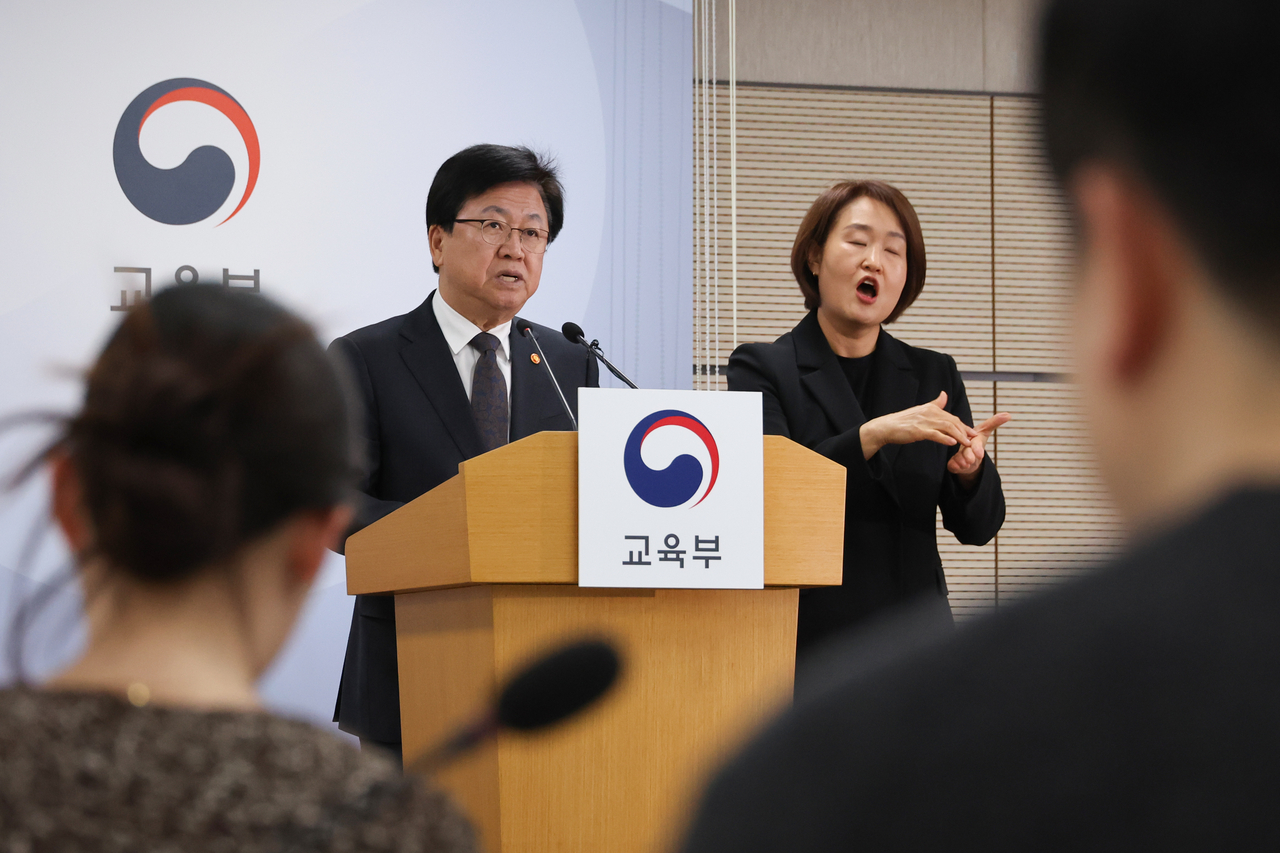
South Korea on Friday confirmed the medical school admission quota for the 2027 academic year will increase to 3,538, as part of a five-year plan to boost the number of newly qualified doctors by 2031.
The Ministry of Education said it has notified universities of the increased medical school admission quotas allocated to select institutions. There will be 490 additional seats in 2027 and 613 more seats annually from 2028 to 2031, compared to the base figure of 3,058 in 2024.
The government emphasized that Friday’s quota allocation was not aimed simply at increasing the number of medical students, but at strengthening the regional health care workforce through the regional doctor system.
The new system allows students to choose the regional doctor track when applying to medical school. If selected, they will receive financial support for their education and training in a designated region before working there for a set period after graduation. The system is intended to address shortages in regional and essential medical services caused by the concentration of medical professionals in the Seoul metropolitan area.
While quotas will increase at regional medical schools, eight institutions in Seoul will maintain their current quotas without any expansion.
Medical school quota hikes by region and university
According to the ministry’s plan, the Busan-Ulsan-South Gyeongsang region saw the largest increase for the 2027 academic year, with 97 additional seats. This was followed by the Daegu-North Gyeongsang region and the Daejeon-South Chungcheong region with 72 seats each, Gangwon Province with 63, Gwangju with 50, North Chungcheong Province with 46, North Jeolla Province with 38, Jeju with 28, and the Incheon-Gyeonggi region with 24.
Smaller medical schools saw larger increases. Kangwon National University and Chungbuk National University recorded the largest hikes, with 39 additional seats each. The increases would nearly double their enrollment, as both schools admitted 49 medical students in 2024.
Medical schools in the greater Seoul region, including Gyeonggi Province and Incheon, saw only single-digit increases. Cha University in Seongnam, Gyeonggi Province, recorded the smallest rise with two additional seats, while Sungkyunkwan University’s medical school in Suwon gained three.
To ensure fairness in allocating quotas, the ministry said it first received quota proposals from universities. It then deliberated the proposals in a newly formed allocation committee composed of experts in medical education.
“The criteria prioritized national universities and sought to ensure that smaller medical schools — those with fewer than 50 seats, which previously accounted for 42.5 percent of all medical school quotas — can secure an appropriate scale,” a ministry official explained.
Additional measures to grow regional medical talent
The government also moved to curb what it called “regional medical schools in name only,” referring to institutions that do clinical training mainly at hospitals in the Seoul metropolitan area rather than in their local regions.
Universities’ plans to improve such practices were reflected in the quota allocation evaluation.
The government pledged large-scale investments in facilities and personnel to ensure that the quota expansion does not undermine the quality of medical education. Universities will upgrade lecture halls and training facilities and gradually expand equipment in line with their increased enrollment.
For national universities, the government plans to provide personnel and facility support, while private universities will receive financial assistance to improve educational environments.
Starting in the 2027 academic year, the government will also establish regional physician support centers to assist students selected through the regional doctor system with academic training and career development after graduation.
Support for university hospitals will also be strengthened. National university hospitals will be developed as key hubs for medical student education and resident training through expanded investment in education and research infrastructure.
The ministry will collect feedback from universities on the preliminary quota allocations through March 24. After a 30-day objection period, final quotas will be confirmed in April. Universities are then expected to complete revisions to academic regulations and admissions plans by May.
Even after the quotas are finalized, the ministry said it will conduct annual inspections of each university’s plan to improve educational conditions. Universities that fail to fulfill their commitments may face disadvantages, such as restrictions on financial support programs or reductions in quotas.
Education Minister Choi Kyo-jin said the number of seats requested by the 32 regional medical schools far exceeded the total planned increase.
“This shows that medical schools recognize their social responsibility to train regional health care professionals,” Choi said. “The Ministry of Education views this allocation as the first step toward establishing the regional doctor system and will continue efforts to ensure a reasonable distribution of quotas.”
seungku99@heraldcorp.com