
Judiciary leaders discuss support measures for criminal court judges and potential impact of new laws on judicial independence
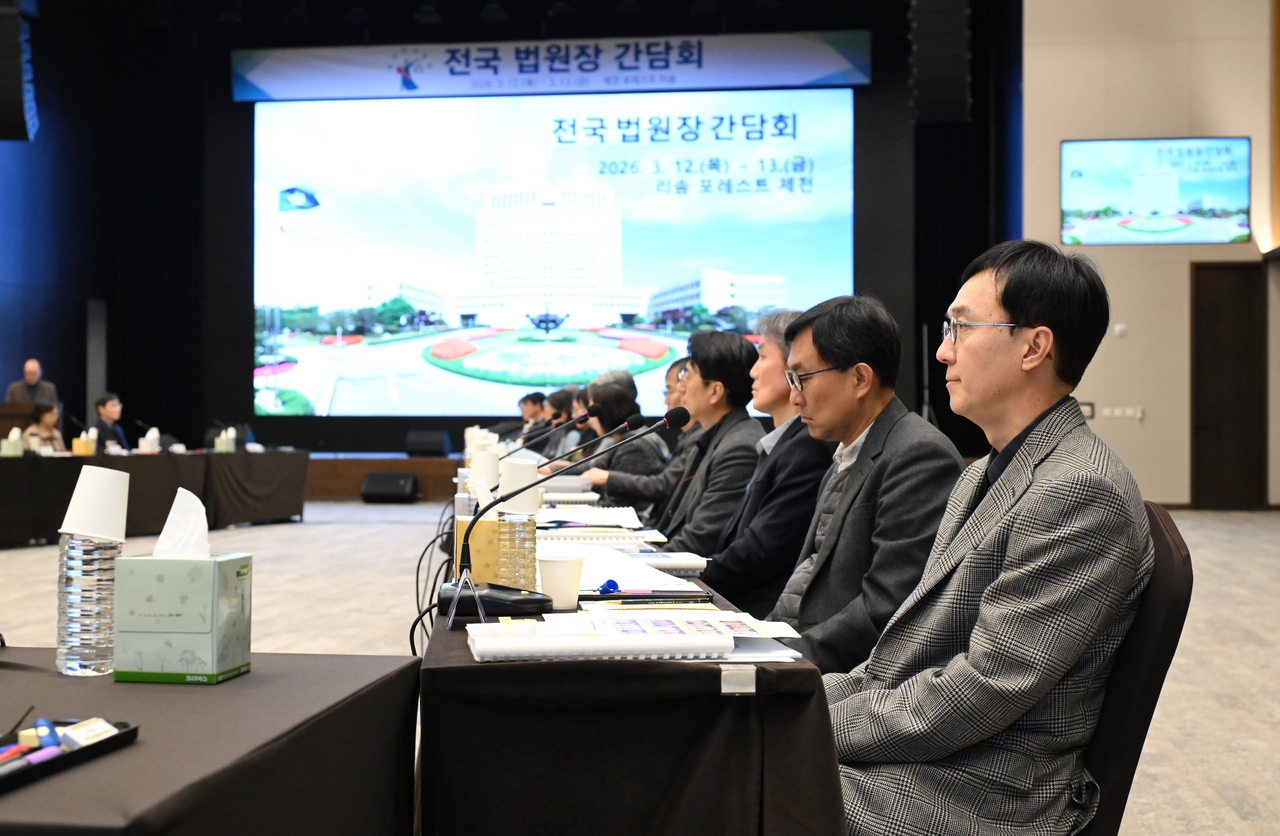
Forty-four chief judges from courts nationwide gathered Thursday in Jecheon, North Chungcheong Province, to discuss follow-up measures after three judicial reform laws took effect the same day.
“There are concerns that the fundamental structure of Korea’s judicial system may change following the passage of the three judicial reform laws,” said Ki Woo-jong, acting minister of the National Court Administration, during the meeting.
The three laws include provisions allowing constitutional complaints against Supreme Court rulings, introducing penalties for judges who intentionally distort legal principles, and expanding the number of Supreme Court justices.
The National Assembly, controlled by the ruling Democratic Party of Korea, passed the bills in February as part of a push for judicial reform, despite strong opposition from the main opposition People Power Party. The judiciary branch also opposed the reform, arguing that the measures could undermine judicial independence.
After the laws took effect, Chief Justice Cho Hee-dae of the Supreme Court was reported to the police on charges of distorting legal principles in a ruling involving President Lee Jae-myung’s election law violation case. In that ruling, Cho overturned a lower court’s acquittal and remanded the case.
The two-day meeting, held Thursday and Friday, focused on follow-up measures related to judicial system reforms and support measures for criminal court judges following the introduction of the distortion of law offense.
“The introduction of the crime of distorting legal principles may increase external pressure on criminal court judges through complaints and criminal accusations, potentially deepening the phenomenon of judges avoiding criminal divisions,” the chief judges said in a statement Thursday evening.
They added that steps must be taken to ensure the changes do not effectively restrict the public’s right to receive prompt and fair trials.
Chief judges discussed expanding budgets to provide legal support for judges who become involved in lawsuits under the new offense. They also proposed establishing a separate committee to help ensure judges can rule independently according to the law and their conscience without being intimidated by potential criminal liability.
Measures were also proposed to protect judges’ personal information to prevent threats to their safety.
Chief judges further suggested prioritizing the assignment of judicial researchers to criminal divisions and increasing related allowances to support judges handling criminal cases.
Regarding the newly introduced constitutional complaint mechanism against court judgments, the chief judges expressed concern that the revised Constitutional Court Act remains unclear and that the absence of related legislative revisions could create confusion in judicial practice and institutional operations.
They discussed issues such as procedures for transferring trial records, how the judiciary should submit opinions, and follow-up steps if such complaints are upheld.
Although the law expanding the number of Supreme Court justices will not take effect until March 2028, chief judges also discussed preparations for the reform.
They warned that increasing the number of justices to 26 could require roughly 100 lower court judges to be reassigned as Supreme Court judicial researchers, potentially weakening lower court capacity and worsening trial delays.
To mitigate such side effects, participants also discussed introducing a “senior judge system” that would allow retired judges to continue handling cases.
seungku99@heraldcorp.com