Expert says speculation about an immediate weakening of deterrence may be overstated
Recent military movements in South Korea are raising questions over whether some United States Forces Korea assets could be redeployed to the Middle East as tensions between Washington and Tehran intensify.
The speculation comes as the conflict in the Middle East appears increasingly likely to drag on, potentially increasing demand for US military assets and prompting the Pentagon to draw on forces stationed overseas.
Such a scenario carries particular weight in Seoul. The “strategic flexibility” of USFK has become a sensitive issue since the Donald Trump administration's return to office, with some observers warning that redeployments could temporarily reduce capabilities designed to deter North Korea.
Seoul and Washington remain silent on the matter, saying only that USFK is focused on the defense of South Korea, but emerging signs have drawn attention.
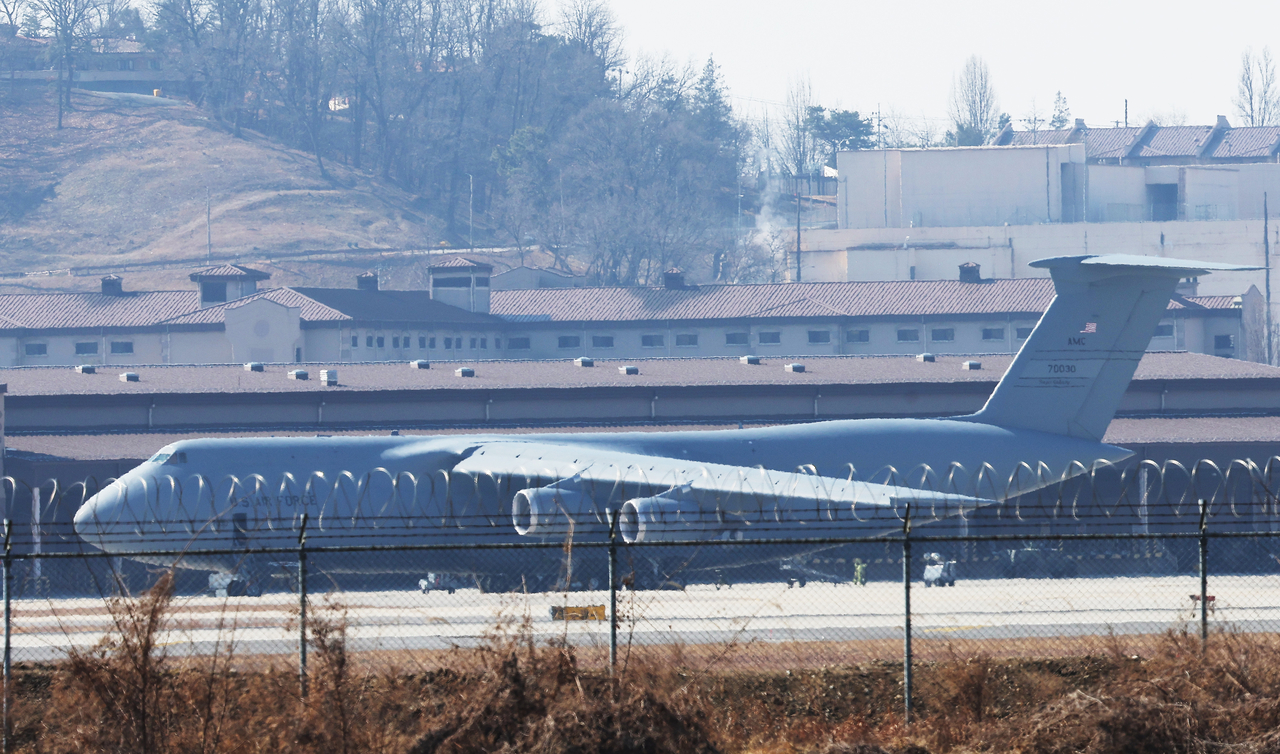
According to flight-tracking data and local reports, several US military transport aircraft that arrived at Osan late last month departed the base in early March.
Among them were at least two C-5 Galaxy aircraft — the US Air Force’s largest strategic airlifter — which landed at Osan in late February before departing on Feb. 28 and March 2. Several C-17 Globemaster III aircraft also departed the base around the same period.
While C-17 aircraft routinely rotate through Osan as part of logistics operations, the presence of the much larger C-5 drew particular attention. According to the US Air Force, the aircraft is designed to transport heavy military equipment such as missile defense systems, including the Patriot interceptor battery.
Earlier reports also indicated that some Patriot batteries, missile defense systems previously stationed at other US bases in South Korea, had recently been relocated to Osan, adding to speculation that some of those assets may have been prepared for transport.
The speculation has been reinforced by precedent.
The United States redeployed Patriot air defense assets from the Korean Peninsula to the Middle East last year during heightened tensions with Iran, before returning them to South Korea later.
Taken together, these developments have fueled concerns that US military capabilities on the peninsula could be reduced if similar redeployments occur again. However, experts say the overall military impact would likely remain limited even if some systems were temporarily moved.
Shin Beom-cheol, former vice defense minister and now head of the Center for Korean Peninsula Strategy at the Sejong Institute, said speculation about an immediate weakening of deterrence may be overstated.
“USFK consists of a wide range of forces with different roles,” Shin said. “Even if some air defense systems such as Patriot batteries were temporarily moved, it would not fundamentally undermine deterrence against North Korea.”
He noted that deterrence on the Korean Peninsula does not only depend on USFK but also on broader US military capabilities in the region, including forces stationed in Japan and assets under the Indo-Pacific Command.
“There are multiple layers of deterrence,” Shin said.
South Korea’s cautious stance also reflects differences from Japan’s approach to the Middle East.
While Seoul has traditionally focused on protecting its citizens and commercial shipping, Tokyo has discussed the possibility of exercising collective self-defense if tensions escalate around the Strait of Hormuz, a critical global energy choke point.
According to The Japan Times, Japanese officials have suggested that Tokyo could consider deploying the Self-Defense Forces should maritime security around the Strait of Hormuz deteriorate.
Analysts say the debate in Japan reflects Tokyo’s long-standing efforts to expand the overseas role of the Self-Defense Forces as part of a broader push to assume a more active military posture abroad.
“By contrast, South Korea has little reason to unnecessarily antagonize Iran,” said Park Yong-han, an associate research fellow at the Korea Institute for Defense Analyses.
Seoul has historically sought to maintain a balanced diplomatic posture in the Middle East, he noted.
Meanwhile, some analysts say North Korea may interpret the developments in mixed ways.
Nam Sung-wook, a professor of diplomacy and unification at Korea University, said Pyongyang could see the movement of US forces as both a potential opportunity and a warning.
“On one hand, North Korea may view it as a sign that US attention is shifting to another theater,” Nam said. “On the other hand, it also demonstrates that US forces based in Korea can be deployed rapidly elsewhere, showing the flexibility and reach of US military power.”
Jo Bi-yeon, a research fellow at the Sejong Institute, said Seoul may also be trying to avoid unnecessary friction with Washington.
“South Korea is in a difficult position where openly criticizing the redeployment of US assets could invite greater demands from Washington,” Jo said.
“If Seoul raises strong objections, it could risk prompting requests for additional security contributions, such as support for operations in the Middle East.”
flylikekite@heraldcorp.com