Democratic members of the US Senate Foreign Relations Committee warned the South Korea-US alliance is facing mounting strain under the Donald Trump administration, citing a series of recent developments ranging from the detention of Korean workers in Georgia to pressure on Seoul to approve massive investments in the US.
In a 56-page minority report titled “The Price of Retreat 2.0: Undermining America’s Economic Edge and Alliance Advantage,” released Tuesday in the US, committee Democrats argued that Washington’s recent policies are unsettling key allies in the Indo-Pacific region, including South Korea.
“The US-South Korea alliance is under strains as well,” the report said, noting that persistent rumors of US troop reductions and other policy signals have raised concerns in Seoul.
The report acknowledged that South Korean President Lee Jae Myung’s visit to Washington in August last year helped stabilize relations, but said the situation deteriorated shortly afterward when more than 300 South Korean workers were abruptly detained by US immigration authorities at a Hyundai battery plant in Georgia.
Combined with ongoing US pressure on the South Korean National Assembly to approve a commitment of $350 billion in investment in the United States through unclear bilateral mechanisms, the measures have unsettled an alliance that is central to America’s economic and security interests in the Indo-Pacific, the report said.
Democratic lawmakers also warned that China appears to be benefiting from the tensions.
According to the report, Beijing has "undoubtedly welcomed speculation" about potential reductions in US troop levels in South Korea, while simultaneously sending its largest aircraft carrier and constructing additional structures in the Yellow Sea that the report described as illegal.
The report also criticized the administration’s handling of regional security issues involving US allies, including Japan and Taiwan. Democrats argued that the administration’s approach risks weakening Washington’s alliances and allowing China to gain strategic advantages.
“Across nearly every domain central to US strategic competition with China — domestic economic dynamism and innovation, diplomacy, strategic partnerships and alliances, and multilateral leadership — the Trump administration has severely weakened US standing on the world stage,” the report said.
The Senate report warned that continued pressure on allies over trade, investment and defense commitments risks undermining the cohesion of US partnerships at a time when Washington is seeking to compete with China for influence in the Indo-Pacific.
Instead of strengthening a unified front among allies, the report concluded, current policies risk pushing partners to “defend themselves alone — or worse, to cooperate with our principal competitor.”
The criticism comes as debates intensify in both Washington and Seoul over the future role of US Forces Korea and broader alliance burden-sharing. Experts note that the latest minority report also reflects Washington’s broader push for “alliance modernization," which envisions greater strategic flexibility for US troops and assets stationed on the Korean Peninsula.
Recent reports suggested that some US missile defense assets stationed in South Korea, including components of the THAAD missile defense system, may have been redeployed to the Middle East amid heightened tensions involving Iran. South Korean military authorities have neither confirmed nor denied such movements, citing operational security.
“The policy pursued during the George W. Bush administration to transform overseas US forces into rapid-response forces has ultimately evolved into what is now described as the concept of alliance modernization,” Park Won-gon, a professor of North Korean Studies at Ewha Womans University, said.
“The strategic trend in Washington is likely to become even stronger — that if necessary, Washington would project USFK not only toward China but to other regions as well.”
Under this framework, USFK would no longer be focused solely on deterring North Korea but could be deployed more flexibly across the Indo-Pacific region or other theaters as needed, Park explained.
The Pentagon’s latest National Defense Strategy also calls on allies to shoulder a greater share of regional security responsibilities. The strategy suggests that South Korea should take “primary” responsibility for deterring North Korea, with the United States providing “critical, but more limited” support.
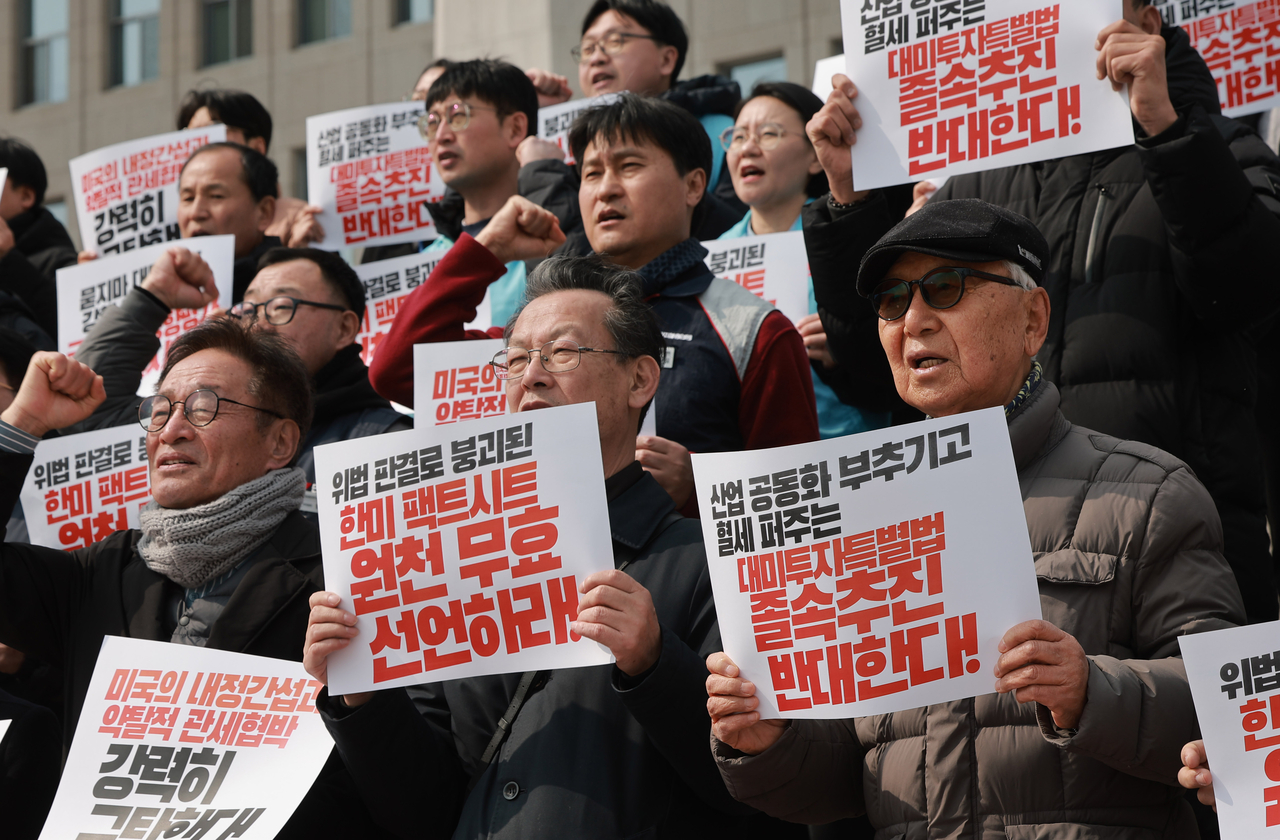
Meanwhile, a bill aimed at creating a government-backed body to manage South Korea’s planned $350 billion investment in the United States passed a National Assembly special committee on Monday.
During a plenary meeting in Yeouido, western Seoul, the committee unanimously approved a revised version of the bill. Lawmakers are expected to bring the legislation to the full Assembly for a vote on Thursday.
The bill proposes establishing a Korea-US strategic investment corporation, which would oversee the implementation of the $350 billion investment outlined in a memorandum of understanding signed by Seoul and Washington last November. The investment plan focuses on key sectors, including shipbuilding and semiconductors.
Under the framework, the South Korean government plans to invest $200 billion in advanced industries in the United States, alongside an additional $150 billion shipbuilding cooperation package led by Korean companies.
South Korean officials have said the legislation could help avert potential US tariff hikes previously threatened by the Trump administration.
mkjung@heraldcorp.com