Hybrid pivot, flexible production lift Korean auto giant to global No. 2
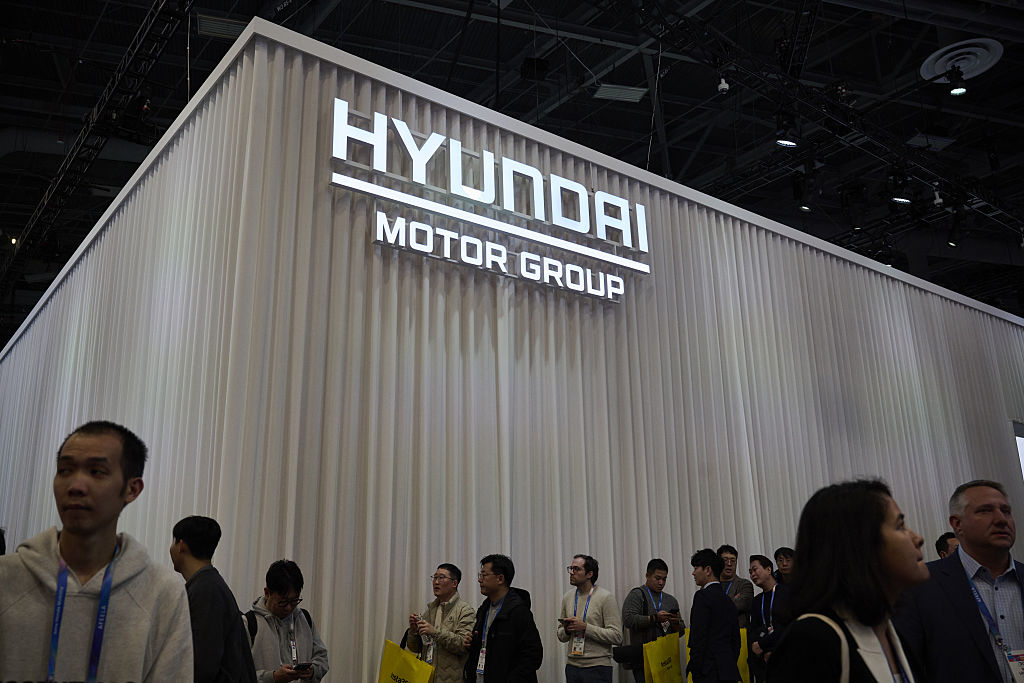
South Korea’s Hyundai Motor Group recorded the world’s second-largest operating profit among global automakers last year, surpassing Germany’s Volkswagen Group for the first time, industry data showed Wednesday.
The group — which includes Hyundai Motor, Kia and luxury brand Genesis — posted 20.5 trillion won ($13.95 billion) in operating profit in 2025. That placed it behind only Toyota Motor Corporation, which topped the list with 4.3 trillion yen ($27.15 billion) in operating profit.
Market watchers said the two Asian automakers emerged as the industry’s most profitable players by quickly adjusting production and inventories to mitigate the impact of tariffs and slowing electric vehicle demand.
The result marks the first time Hyundai Motor Group has ranked second globally in operating profit, despite selling fewer vehicles than Volkswagen Group, which remains the world’s second-largest automaker by sales volume with brands including Volkswagen, Audi and Porsche.
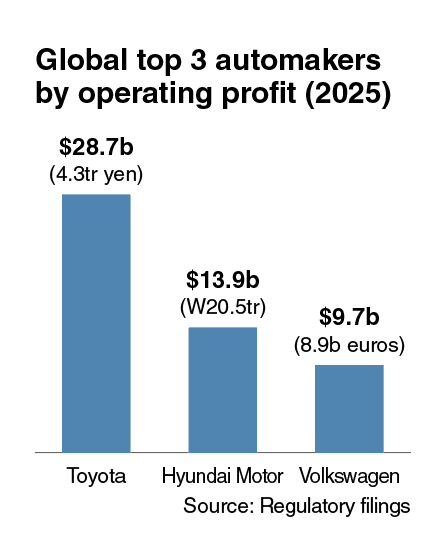
General Motors ranked third with $12.7 billion in operating profit, followed by Volkswagen Group in fourth with 8.9 billion euros ($10.34 billion).
Stellantis, meanwhile, reported an operating loss of 840 million euros.
Hyundai Motor Group also ranked second in operating profit margin, posting 6.8 percent, behind Toyota’s 8.6 percent and more than double Volkswagen’s 2.8 percent.
Hybrids cushion EV slowdown
Hyundai Motor Group sold 7.27 million vehicles globally last year, maintaining its position as the world’s third-largest automaker.
Toyota Motor Corporation remained the top seller with 11.32 million vehicles, followed by Volkswagen Group with 8.98 million. General Motors ranked fourth with 6.18 million, while Stellantis sold 5.48 million vehicles.
Analysts said automakers’ responses to the EV slowdown and US tariffs played a major role in shaping profitability across the industry.
Hyundai Motor Group adopted a flexible production strategy, shifting output toward hybrid models to offset weakening EV demand.
The group sold more than 1 million hybrid vehicles globally last year, with Hyundai Motor’s hybrid sales jumping 32 percent year-on-year.
“Despite challenging global conditions, Hyundai performed relatively well, supported by its competitive full-hybrid vehicles that offer strong fuel efficiency and broad appeal in global markets,” said Kim Pil-su, a professor of automotive engineering at Daelim University. “The company’s key strength lies in deploying the right models and branding strategies tailored to each region.”
Tariffs reshape global competition
Tariffs also emerged as a key challenge in the United States, Hyundai Motor Group’s largest overseas market, which accounts for about 24 percent of its global sales.
Despite both Hyundai Motor and Kia reaching record revenue last year, tariffs weighed on profitability, with Hyundai’s profit down 19.5 percent and Kia’s 28.3 percent from a year earlier.
Analysts said the tariff burden was not unique to Hyundai but affected automakers across the board, reshaping competition in the global auto industry. While many rivals responded by raising prices or adjusting supply, Hyundai Motor Group minimized price increases and focused on operational adjustments and expanding local production.
The strategy helped the group achieve record US sales of 1.83 million vehicles last year, the highest in its history.
Meanwhile, Volkswagen’s profits were hit hard by US tariffs and falling sales in China amid intensifying local competition. Europe’s largest automaker described 2025 as a “challenging environment” after reporting Tuesday that its operating profit fell more than 50 percent from a year earlier.
Hyundai Motor Group also faced lower tariff expenses than Toyota.
The Korean automaker paid about 7.2 trillion won in tariffs last year — including 4.1 trillion won for Hyundai Motor and 3.1 trillion won for Kia — compared with Toyota’s 1.2 trillion yen.
South Korean-made vehicles exported to the US are currently subject to a 15 percent tariff, reduced from 25 percent previously.
Experts say challenges still loom this year amid geopolitical tensions in the Middle East and ongoing tariff uncertainties.
“There are still too many uncertainties, including Trump’s policies, ongoing wars and shifting tariff rules,” said Kim. “To navigate tariff pressures and geopolitical disruptions, Hyundai needs to keep producing vehicles in the US for the American market while maintaining strong manufacturing bases in Korea for other regions, alongside deploying region-specific models.”
sahn@heraldcorp.com