Renowned Korean calligrapher Kang Byung-in, known for designing iconic Hangeul lettering for popular brands and cultural works, spoke about the philosophy and artistic structure of the Korean alphabet during a lecture Tuesday at the New Zealand ambassador’s residence in Seoul.
The lecture, titled “Hangeul Calligraphy and the Spirit of Hangeul,” was hosted by the Corea Image Communication Institute as part of its Korea CQ Forum series.
More than 10 opinion leaders attended the event, including diplomats such as New Zealand Ambassador Dawn Bennet, Norwegian Ambassador Anne Kari Hansen Ovind, Austrian Ambassador Eva Russek and Luxembourg Ambassador Jacques Flies.
During the lecture, Kang discussed the historical and philosophical foundations of Hangeul, created by King Sejong in the 15th century.
“The spirit behind the creation of Hunminjeongeum was Sejong’s ability to think differently,” Kang said, referring to Hangeul by its original name. “Hangeul’s beauty lies in its structure and the way it enables creation, expression and design.”
He noted that Hangeul’s design is rooted in a systematic and scientific structure.
“I’m not saying Hangeul is unconditionally the most beautiful script in the world,” he said, “but it has a unique system that allows endless possibilities for artistic expression.”
Kang began studying calligraphy after being encouraged by his sixth-grade teacher, whom he described as his first mentor. Nature, he added, has been another enduring source of inspiration.
He also cited the influence of renowned Joseon-era calligrapher Kim Chong-hui, also known as Chusa, whose work inspired him to reinterpret classical calligraphic traditions through Hangeul.
Rather than simply copying classical Chinese-character calligraphy, Kang said he sought to translate its spirit into the Korean script.
Over the years, Kang has created lettering for numerous commercial and cultural projects, including Chamisul soju, Hwayo liquor and Yeol Ramyeon, as well as titles for films and television dramas like "Misaeng."
He also explained the scientific principles behind Hangeul’s design, noting that consonants were modeled after the shapes of human speech organs while vowels reflect philosophical concepts representing heaven, earth and humanity.
“Hangeul becomes a complete character only when its elements come together,” Kang said. “When written as a block, it gains dimensionality and sound.”
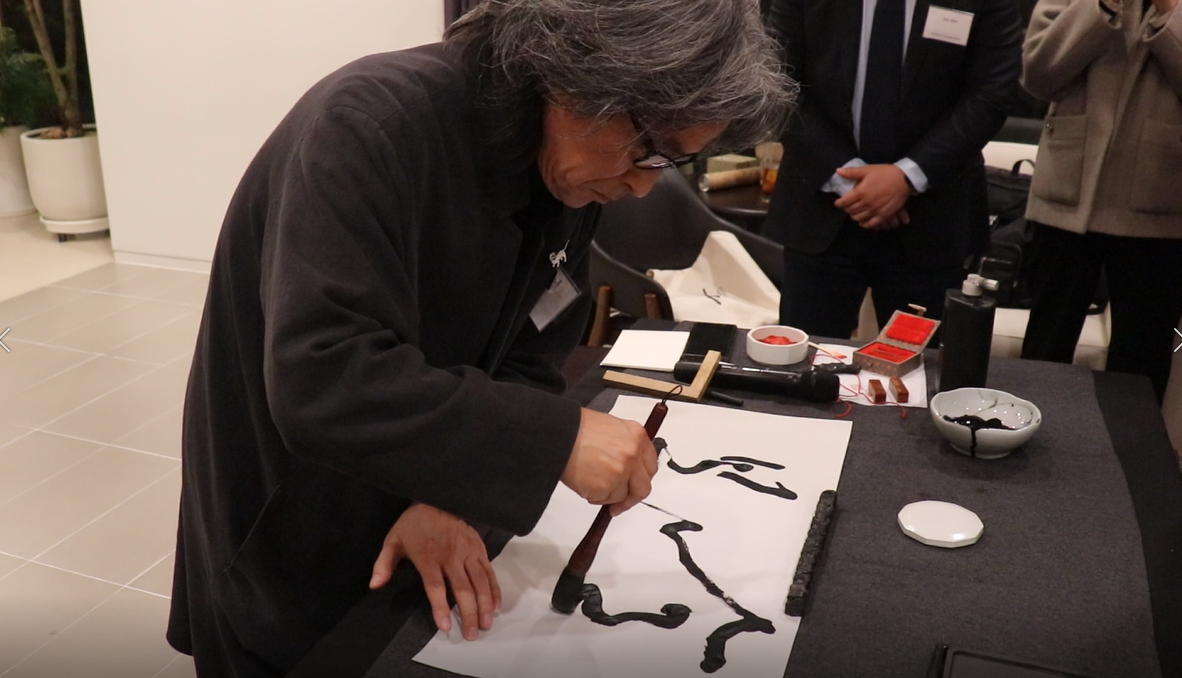
Following the lecture, Kang held a live calligraphy session for guests, writing their favorite Korean words on site for the attending ambassadors and participants.
yoohong@heraldcorp.com