Successful listing could hand Chung Euisun billions, easing tax burdens, paving way for governance reform
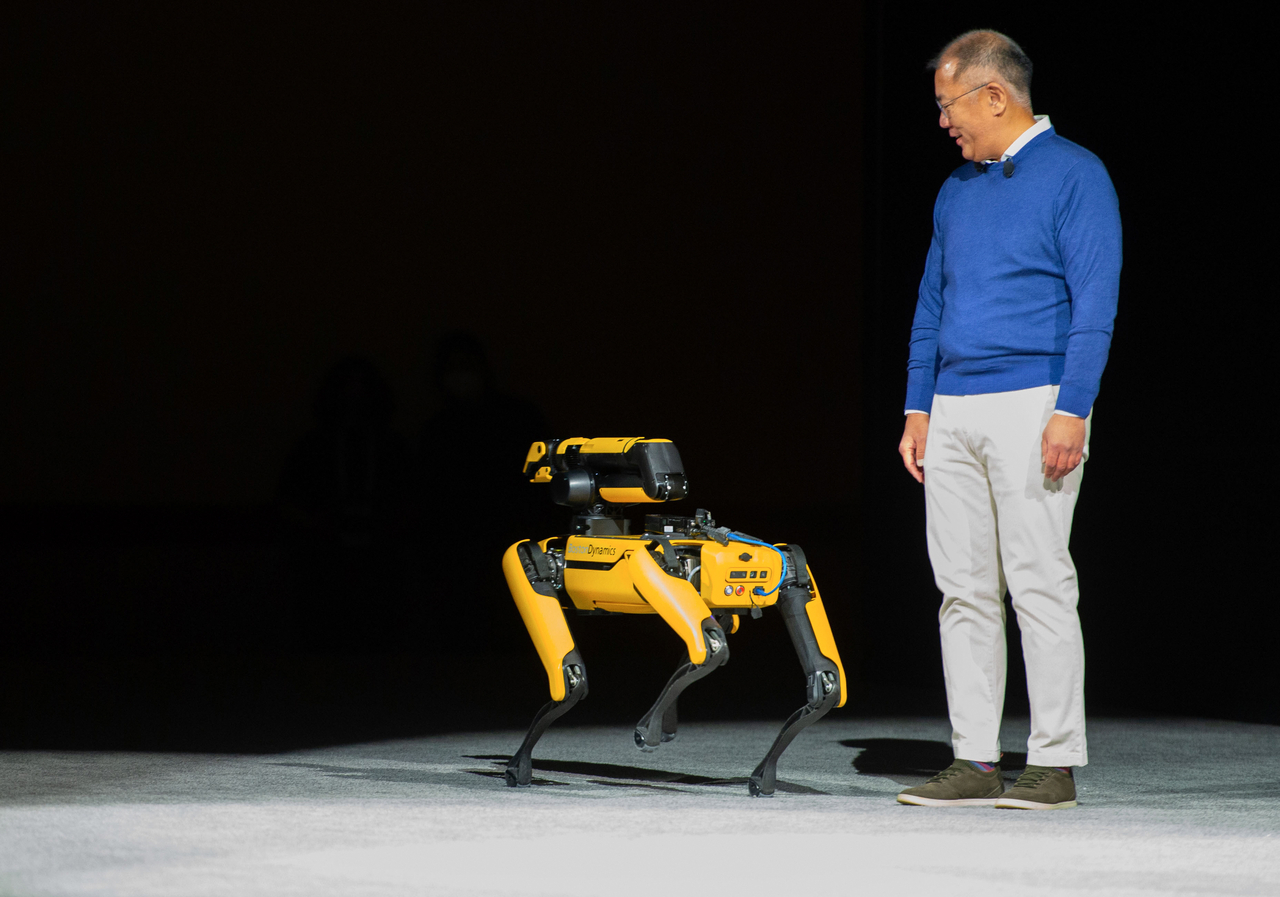
Hyundai Motor Group’s decadeslong effort to streamline its complex ownership structure could finally gain momentum. The catalyst is not a new SUV, but the company behind the back-flipping humanoid robot Atlas.
Boston Dynamics, the auto-to-steel conglomerate’s US robotics unit, will work toward a long-anticipated initial public offering on the Nasdaq this year, according to sources. With a potential listing as early as 2027, the company is expected to select underwriters and file for a preliminary review with Nasdaq.
With Hyundai Motor Group Executive Chair Chung Euisun holding a 20 percent stake in Boston Dynamics, a successful listing could provide Chung a war chest of as much as 20 trillion won ($13.58 billion) in funds, according to estimates by local brokerages. The substantial amount could provide the third-generation leader with the financial resources needed to settle future inheritance taxes and strengthen his grip on the auto giant’s intricate web of cross-shareholdings.
Imminent IPO?
Signs of an imminent IPO have emerged at Boston Dynamics recently.
The departure of longtime CEO Robert Playter last month signaled the transformation from the engineering-driven culture that had defined the company since its MIT origins, toward a more commercially oriented structure now led by interim CEO and CFO Amanda McMaster, observers say.
Hyundai Motor Group has also established a dedicated robotics and artificial intelligence strategy task force under Vice Chair Chang Jae-hoon, a move analysts say aims to pave the way for a potential IPO of Boston Dynamics and deal with investments and governance restructuring.
A Boston Dynamics IPO has long been discussed within the group and the broader market.
Hyundai Motor Group acquired the company from SoftBank in June 2021 with its affiliates — Hyundai Motor, Hyundai Mobis and Hyundai Glovis — collectively investing $660 million for a 60 percent stake. Chung also paid for a 20 percent stake out of his own pocket, bringing the group’s combined ownership to 80 percent.
At the time of acquisition, Hyundai committed to taking the company public within four years — a deadline that lapsed in June 2025, and the failure to list would grant SoftBank the right to exercise a put option. SoftBank currently has until June 2026, an additional one-year grace period, to exercise that option.
Subsequent capital raises across three rounds have lifted Hyundai affiliates' ownership to approximately 68 percent, while Chung’s personal stake has grown to 22.6 percent and SoftBank's is at 9.5 percent, according to iM Securities.
“Hyundai Motor Group has continued to prepare for a potential IPO of Boston Dynamics, a process that is expected to gain momentum when SoftBank exercises its put option,” said Kim Yong-min, an analyst at Yuanta Securities, adding it appears less likely for SoftBank to hold onto the remaining shares.
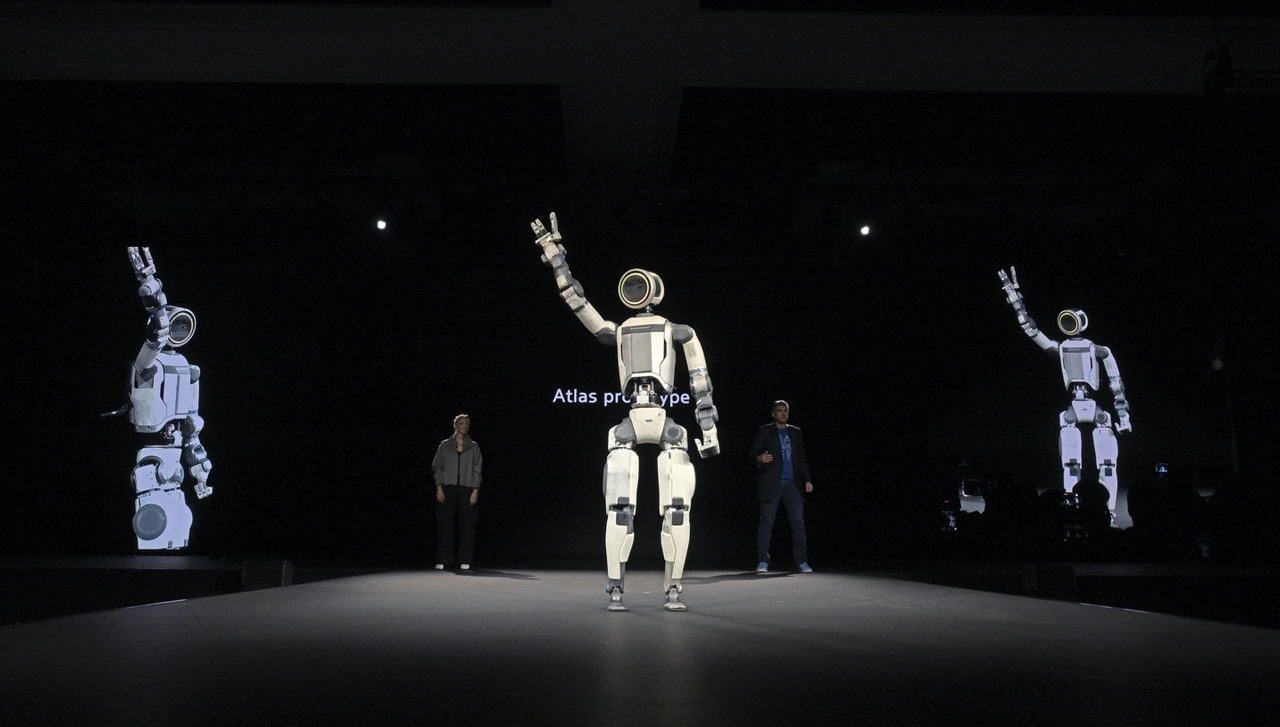
In response to market speculation, Hyundai has remained mum on the timeline, but hinted it is open to exploring an IPO during conference calls.
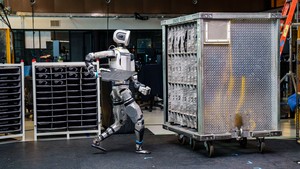
With the company's Atlas making a blockbuster debut at CES this year, and growing expectations around expansion and mass production in the robotics industry, valuation estimates of Boston Dynamics are increasing. Observers say Hyundai appears to be playing the long game, waiting for the most opportune moment to maximize returns. As market enthusiasm continues to build, an IPO looks ever more imminent.
Unlocking complex circular ownership
Chung’s stake of over 20 percent in Boston Dynamics — acquired for roughly $220 million in 2021 — could be worth over $13.6 billion or more based on current brokerage estimates, representing an extraordinary return on his initial investment.
This is based on multiple firms valuing Boston Dynamics at over 100 trillion won, with KB Securities placing it at about 128 trillion won and Hanwha Investment & Securities projecting as high as 150 trillion won, driven by expected growth in the humanoid robot market. Other brokerages put the valuation at around 40 trillion won to 60 trillion won.
For years, Hyundai has faced scrutiny over its circular ownership, being the only major conglomerate that still has the complex structure.
Within this arrangement, three ownership loops exist within the group. The primary one runs from Hyundai Mobis as the largest shareholder of Hyundai Motor, which controls Kia and then circles back as the largest shareholder of Hyundai Mobis.
The remaining two cycles follow a similar pattern, each originating from Hyundai Mobis and routing through Hyundai Motor and running through affiliates Hyundai Glovis and Hyundai Steel, respectively, before circling back.
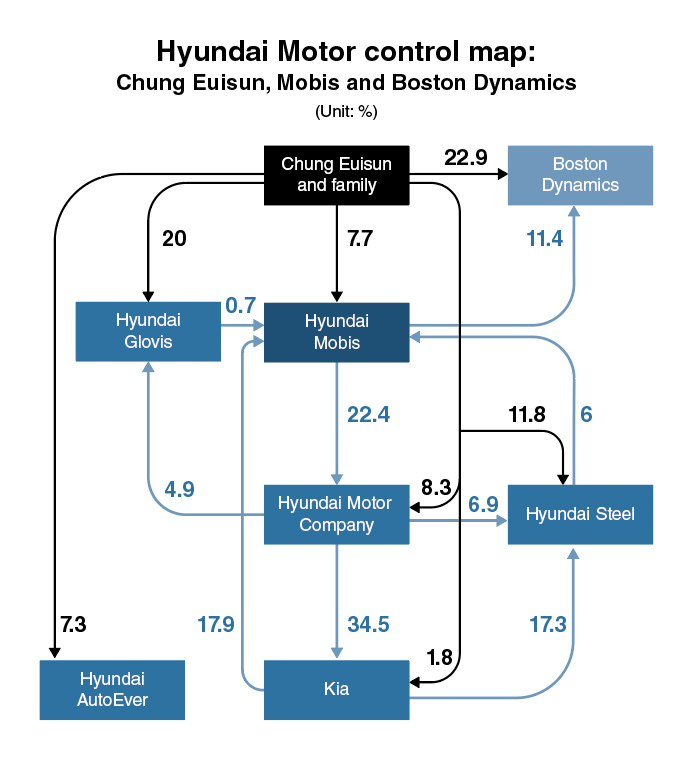
At the top of the chain is parts-maker Hyundai Mobis, which controls Hyundai Motor with a roughly 22.4 percent stake, effectively serving as the group’s de-facto holding company.
This interlinked structure has effectively allowed the Chung family to solidify its grip of the entire conglomerate through relatively modest direct stakes in the key affiliates.
But Hyundai has been under persistent pressure from investors and regulators to unwind its circular shareholding structure. In 2018, the conglomerate attempted to overhaul its structure, but the effort was ultimately scrapped following strong opposition from shareholders and activist funds.
Amid increasing calls for restructuring and in order for Chung to remain in effective control of the group, he will eventually have no choice but to revamp governance, observers say. To do so, Chung needs to increase his stake in Hyundai Mobis — currently 0.3 percent — by buying out shares held by Kia and Hyundai Steel. Chung’s father, Honorary Chair Chung Mong-koo owns a 7.29 percent stake in Mobis, which is expected to be inherited by Chung Euisun.
The proceeds from the IPO could help Chung cover this financial burden, including inheritance and gift taxes on shares held by the senior Chung, and to purchase Hyundai Mobis shares from other group affiliates.
With the senior Chung’s stakes in Hyundai affiliates exceeding 7 trillion won, a simple inheritance tax rate of 60 percent would mean it could cost more than 4 trillion won in tax alone, according to Yuanta Securities.
"Assuming a Boston Dynamics' IPO moves forward, a favorable window for Hyundai Motor Group's governance overhaul may be fast approaching," said analyst Kim. "The IPO could give Chung the financial foundation. Should Hyundai acquire SoftBank's remaining stake in June and initiates IPO process, a 2027 listing could well be the trigger for the restructuring."
sahn@heraldcorp.com