Circuit breaker, sidecar activated as foreign investors lead sell-off, oil surge fuels inflation fears
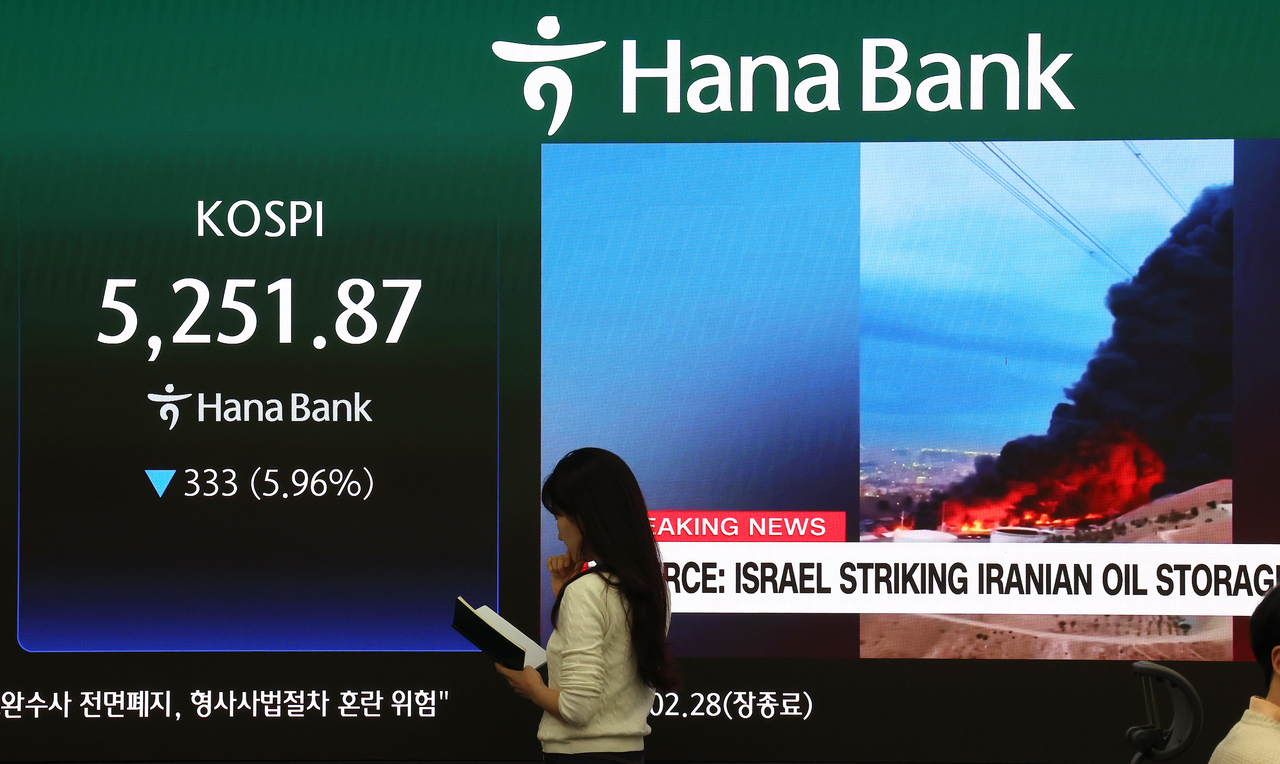
A surge in global oil prices triggered by the war in the Middle East rattled investors Monday, raising concerns about renewed global inflation pressures and weighing heavily on both South Korea’s stock market and the local currency.
Higher oil prices are stoking inflation concerns for Korea, a country heavily dependent on energy imports. Rising import costs reduce production efficiency and could deal a major blow across the industrial supply chain, putting additional pressure on the bourse.
Pricing in such concerns, the country's benchmark Kospi plunged 5.96 percent from the previous session to close at 5,251.87. The index declined during trading to as low as 5,096.16, down 8.75 percent, but managed to pare some of the losses in the afternoon.
A sell-side sidecar was triggered on the main bourse at 9:06 a.m., halting program sell orders for five minutes. This was followed by the activation of a circuit breaker — a 20-minute suspension of trading — at 10:31 a.m.
It was the second circuit breaker activated this month, following the first on March 4, and it was the eighth on record.
Foreign and institutional investors led the sell-off, offloading a net 3.18 trillion won ($2.13 billion) and 1.54 trillion won worth of shares, respectively. Retail investors stepped in as buyers, purchasing a net 4.62 trillion won in shares, but the inflow was not enough to offset the heavy selling.
Sharp losses in large-cap stocks weighed on the benchmark. Samsung Electronics dropped 7.81 percent to 173,500 won, while SK hynix plunged 9.52 percent to 836,000 won. Hyundai Motor fell 8.32 percent to 507,000 won, and LG Energy Solution declined 4.77 percent to 359,500 won.
The tech-heavy Kosdaq also dropped sharply, closing down 4.54 percent at 1,102.28. The index extended losses in early trading, triggering a sell-side sidecar at 10:31 a.m.
“Rising oil prices can affect the Korean economy through several channels,” said Jo Ah-in, a researcher at Samsung Securities, pointing to higher transportation costs, increased energy expenses and inflationary pressures through global liquidity conditions.
“However, if the oil price surge stabilizes within one or two months, the risk of it feeding into broader global inflation remains limited,” she added.
The Korean won also weakened sharply against the dollar, pricing in the oil shock. The currency wrapped up daytime trading at 1,495.5 per dollar, losing 19.1 won in value from the previous session. During trading, it briefly depreciated to 1,499.2 per greenback.
The 1,495.5 won-per-dollar close marks the weakest daytime finish for the Korean currency since March 12, 2009, when the won ended at 1,496.5 per dollar during the global financial crisis. It also surpasses the 1,484.1 won close on April 9, when Korea was hit by the “reciprocal” US tariffs.
Grappling with the oil price surge, the currency continued to fluctuate in the 1,490s throughout the session. Though the won temporarily strengthened to the low 1,490-won range after the government and the Bank of Korea hinted at potential interventions, it later retreated to the mid-1,490 won range by the close.
silverstar@heraldcorp.com