The establishment of international schools is re-emerging as a major education pledge ahead of the local elections across Korea scheduled for June 3.
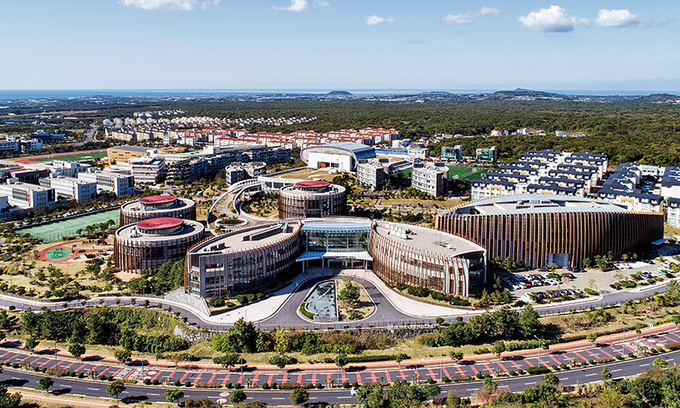
Supporters of the plans cite the example of Jeju Island, which hosts four international schools and has used them to help revitalize rural areas, presenting international schools as a way to transform local communities.
They say the schools could provide an environment attractive to global talent and draw Korean demand for overseas education back to the country, helping address regional population decline.
However, past experiences suggest a far more uncertain outlook, with multiple attempts to establish international schools stalling or taking years to get off the ground.
Meanwhile, the schools in Jeju are facing declining enrollment as both accredited and unaccredited international schools proliferate nationwide.
Ministry objections
In Gangwon Province, the issue of establishing an international school has emerged as a key topic even before the full-scale campaign period begins.
The issue resurfaced after the Education Ministry reportedly asked for the removal of a provision in a revision to the Special Act on the Establishment of Gangwon Special Self-Governing Province that would grant the province authority to establish an international school.
The revision, proposed by the province and currently under review at the National Assembly, is part of broader efforts to expand Gangwon’s autonomy in promoting economic growth and responding to population decline.
“I recently received a phone call asking to remove the related provision, and I found it very shocking,” Gangwon Gov. Kim Jin-tae of the main opposition People Power Party said Tuesday.
“The central government should take part in consultations with a positive attitude and consider the issue from a broader perspective,” he added.
Woo Sang-ho, former senior secretary for political affairs to President Lee Jae Myung and the sole Gangwon gubernatorial candidate from the ruling Democratic Party of Korea, also said he would ensure the province secures the necessary authority if the issue becomes contentious.
“I have consulted with the central government on the matter, and if problems arise, I will address them immediately by meeting with the education minister,” Woo said Thursday after registering as a candidate for governor.
Gangwon is not the only region where international schools have emerged as an election pledge.
Preliminary candidates in multiple provinces and cities, including North Gyeongsang Province, Sejong, and Cheonan in South Chungcheong Province, have also raised similar proposals. Such pledges have been made by candidates for governor, mayor and even local council positions.
Demographic crisis
International schools offer English-based curricula and high admission rates to overseas universities, while allowing only a limited percentage of domestic students with approval from the education authorities.
Despite their high cost, which can reach about 60 million won ($40,400) annually, including tuition and other expenses, supporters say the schools could attract global professionals who hesitate to relocate to regional areas due to concerns about their children’s education. The presence of such schools could also encourage international companies to establish local operations, they say.
Supporters also point to the potential for Korean families to access a global learning environment without sending their children abroad, which local governments see as one way to ease the impact of population decline in regions outside Seoul.
The number of regional communities classified as being at risk of extinction — where women aged 20 to 39 number less than half of those aged 65 or older — nearly doubled from 61 in 2010 to 119 in 2023 as birth rates and inward migration declined while aging accelerated.
The case of Jeju Island partly supports these expectations.
All four international school campuses on the island are located in the rural town of Daejeong-eup, about 35 kilometers from downtown Jeju City. Despite its distance from the airport, the town’s population rose from around 17,000 in 2010 to 21,600 in 2025, according to the government.
Authorities also estimate that the schools have absorbed education spending worth 1.42 trillion won that might otherwise have been spent on overseas study since 2011.
Uncertainty ahead
The recent situation in Jeju, however, suggests the impact of international schools may be more limited than many local politicians hope. Protracted or failed attempts elsewhere also reveal significant challenges in establishing such schools.
The number of students enrolled in Jeju’s international schools has declined in recent years, falling from 4,868 in 2023 to 4,133 in 2025. The enrollment rate has also dropped from 90 percent to 71.7 percent.
Observers point to several factors behind the decline, including limited residential infrastructure in the Daejeong-eup area and a general decrease in the school-age population nationwide. Unaccredited international schools, which do not provide academic credentials recognized by the Korean education system, are also absorbing part of the demand.
According to a report by International School Consultancy, about 130 unaccredited international schools were operating in Korea as of 2023, with around 26,000 students enrolled.
Amid growing concerns about the sustainability of Jeju’s international schools, Jeju Gov. Oh Young-hun pledged expanded support during a meeting with school officials in February.
“We will review various policy measures so that the Global Education City can establish itself as a global hub for residential education services,” he said.
Growing competition, persistent hurdles
At least eight cities, including Busan, Incheon and Ulsan, are pursuing plans to establish international schools by 2030 based on previous pledges, as competition to attract such schools intensifies.
While some have already signed agreements with renowned international schools, others have faced obstacles, highlighting the challenges of establishing schools in new regions.
Challenges include uncertainty over future demand, high construction costs and opposition to using public funds for schools that only a small number of families can afford.
Changwon in South Gyeongsang Province, for example, cut the related budget in December after two unsuccessful attempts in 2011 and 2017.
Local officials say many procedures remain under review, citing differences with the Gyeongsangnam-do Office of Education and difficulties securing land for the project.
Experts urge a more prudent assessment of plans to establish international schools, warning that attracting premium school brands may require large amounts of taxpayer money.
They say demand for international schools in remote areas may be limited, as foreign schools serving foreign nationals already operate in Seoul and other major cities.
“Even considering Jeju’s unique circumstances as a leisure destination, it is hard to say all the schools there are successful,” said Kim Sang-bong, an economics professor at Hansung University.
“More in-depth analysis of demand is needed, as whether schools in remote regions far from Seoul can attract enough students remains highly uncertain," Kim added.
forestjs@heraldcorp.com