By Korean Food Promotion Institute
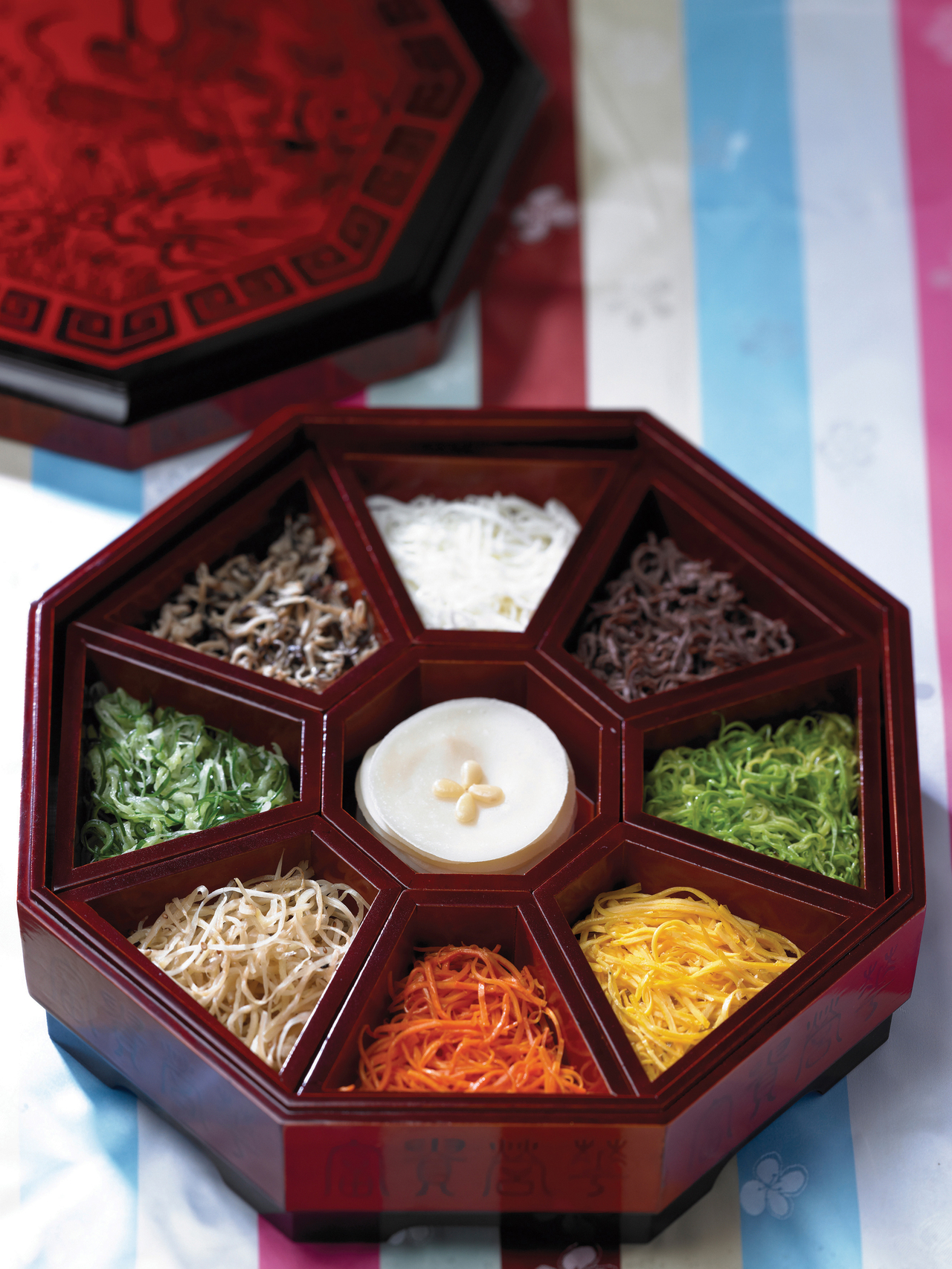
Gujeolpan is one of the most visually refined dishes in traditional Korean cuisine, once served in royal court banquets. Named after the nine-sectioned platter used to present it, the dish highlights balance in color, texture and flavor — a defining principle of Korean culinary philosophy. Thin wheat crepes are wrapped around vegetables, beef and seafood, then dipped in a sharp mustard sauce or soy-vinegar dressing. Though it requires careful preparation, gujeolpan is ultimately a communal dish designed to be assembled and enjoyed at the table.
Ingredients
- 120 grams beef (top round)
- 2/3 English cucumber
- 1 cup saltwater
- 100 grams mung bean sprouts
- 1/3 carrot
- 6 dried pyogo (shiitake) mushrooms
- 100 grams small shrimp, peeled and deveined
- 3 eggs
- Vegetable oil, sesame oil, salt, pine nuts as needed
Marinade for beef
- 2 tablespoons soy sauce
- 1/2 tablespoon sugar
- 1 teaspoon minced green onion
- 1/2 teaspoon minced garlic
- 2 teaspoons sesame oil
- 2 teaspoons toasted sesame seeds, crushed
- Pinch of ground black pepper
Flour crepes
- 1 cup all-purpose flour
- 1/2 teaspoon salt
- 1 1/4 cups water
- 1 tablespoon vegetable oil
Mustard sauce
- 2 tablespoons mustard powder
- 1 tablespoon water
- 1 tablespoon white vinegar
- 1/2 teaspoon salt
- 1/2 tablespoon sugar
Cho-ganjang (Soy sauce with vinegar)
- 2 tablespoons soy sauce
- 1 tablespoon white vinegar
- 1 tablespoon water
- 1/2 tablespoon sugar
Preparation
Cut the beef into fine strips along the grain. Combine the ingredients for the marinade in a small bowl and add the beef. Marinate the beef for 10 minutes.
Cut the cucumber into 4 cm pieces. Peel the cucumber into a single, continuous paper-thin sheet while rotating the cucumber; stop cutting once seeds are reached. Cut the sheet into fine strips. In a small bowl, make the saltwater and soak the cucumber for 10 minutes. Drain and squeeze out the excess moisture.
Separate the heads and tails of the mung bean sprouts.
Cut the carrot into 4 cm pieces, and then julienne
Remove the stems of pyogo mushrooms. Slice them thinly, and julienne
To make the crepe batter, combine the flour and salt in a medium bowl then whisk water in gradually. Pass the batter through a fine sieve to remove lumps and set aside.
To make the mustard sauce, mix the prepared mustard paste with the vinegar, salt and sugar. You could use commercial mustard paste instead of powder, and mixture of vinegar, sugar and water as well.
In a small bowl, combine all the ingredients for cho-ganjang and mix well.
Separate egg yolks and egg whites into two bowls and beat them well with a pinch of salt.
Finely chop the pine nuts.
Cooking
Blanch the mung bean sprouts in boiling water for 1 minute and rinse in cold water directly. Squeeze out the excess water.
Cook the shrimps in boiling water until they turn pink and are cooked thoroughly. Drain and set aside to cool. Cut the shrimps in half.
Heat sesame oil in a pan. Quickly stir-fry the salted cucumbers.
In another pan, heat sesame oil. Lightly stir-fry the mung bean sprouts, pyogo mushroom and carrot separately with a pinch of salt.
In another pan, heat the vegetable oil over high heat and lightly stir-fry the beef
Pan-fry the yolks and whites separately in a lightly greased skillet over low heat to form very thin sheets. Cut them into 4 cm long fine strips.
Lightly coat a non-stick skillet with the vegetable oil. Drop a spoonful of batter onto the pan to make very thin crepes about 8 cm in diameter. Cook crepes until the edges are opaque. Turn them over and cook a little more. Let them cool on a tray.
Layer the crepes in the center compartment of the serving dish, sprinkling crushed pine nuts between the layers to prevent them from sticking together. Place each of the prepared vegetables in the eight side compartments, ensuring those with the same color sit opposite each other.
Serve with a small bowl of mustard sauce or cho-ganjang on the side.
To eat, put a little of every ingredient on a crepe with the mustard sauce or cho-ganjang, and then roll it up.
Tip
Gujeol-pan is a signature dish that features Korea’s five cardinal colors: red, green, yellow, white and black. Gujeol-pan is the name of both the serving dish and the food. If a nine-partitioned plate is unavailable, a large plate may be used.
Serve 4.
yoohong@heraldcorp.com