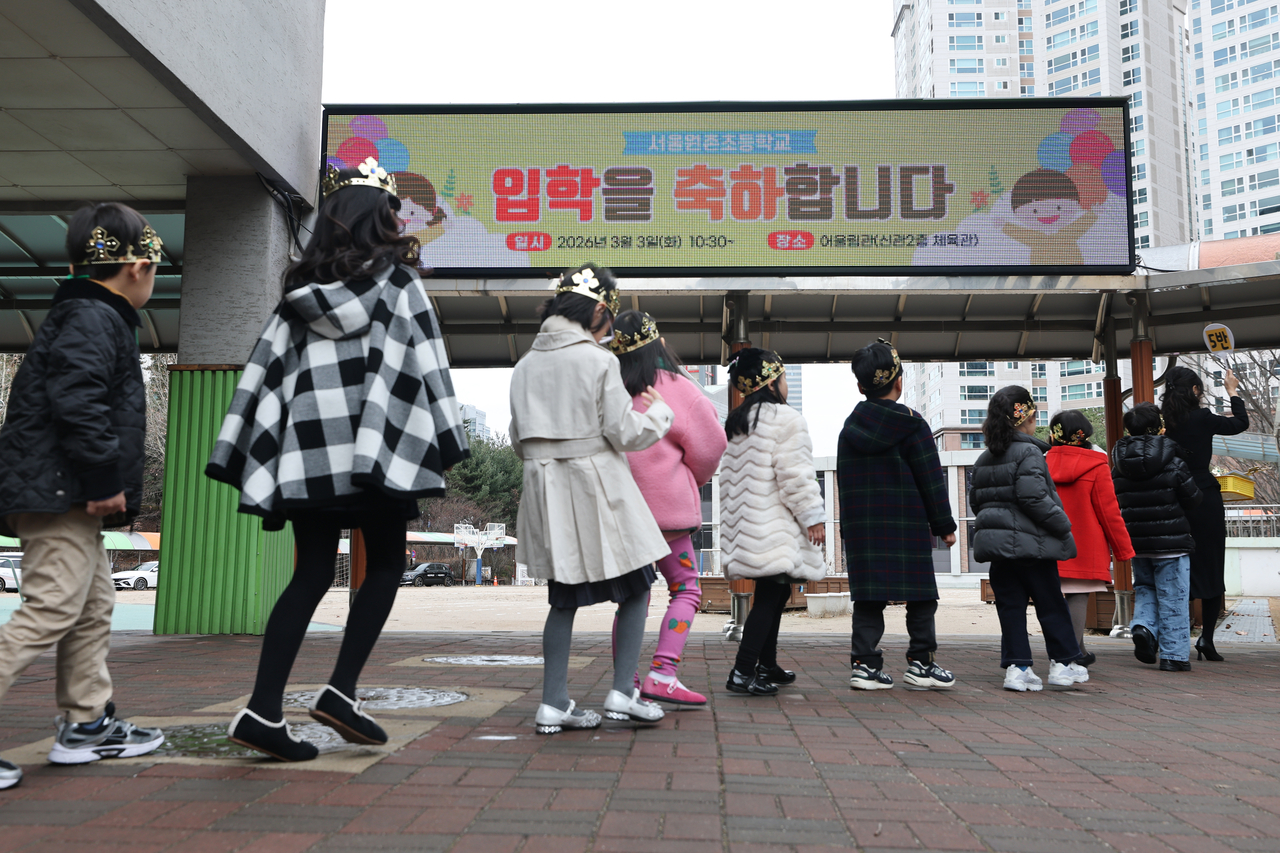
The gap in first-grade enrollment at elementary schools has widened sharply this year, reaching a 59-fold difference between schools within the same district. As a result, some campuses face potential closure, while others contend with overcrowded classrooms.
Researchers attribute the imbalance to a combination of factors, including differences in educational environments and the impact of new housing developments near certain schools. They also point to a growing tendency among parents to avoid lower-priced housing areas, which has accelerated the concentration of students at certain campuses.
As the gap increasingly affects education quality and the efficient allocation of public resources, experts say policies must address housing and asset disparities, alongside broader support for public education.
According to data released Wednesday by the Seoul Metropolitan Office of Education, schools in Seodaemun-gu showed significant variation in new elementary school enrollment. As of the last week of February, the number of incoming first-graders ranged from four to 237 in the same district.
The phenomenon is not limited to Seodaemun-gu.
Other districts in Seoul, including Gangnam-gu, Seocho-gu, Gwanak-gu and Yongsan-gu, recorded enrollment gaps ranging from 15 to 32 times. In some cases, stark contrasts between neighboring schools have left certain institutions at risk of closure, with only single-digit or even no new entrants this year.
The imbalance appears particularly pronounced in Seoul, where a dense concentration of schools within a compact area gives parents greater choice, intensifying competition among campuses.
An October report by the Korean Educational Development Institute found that Seoul recorded enrollment gaps of up to 1,050 students between schools located within a 500-meter radius. Busan, Incheon and Gwangju followed with gaps of 838, 788 and 787 students, respectively.
“Localized polarization shows a structural concentration toward preferred schools and avoidance of less favored ones,” a researcher at the Korean Educational Development Institute said. The report added that school hierarchization and location preference effectively influence school size even at the elementary level.
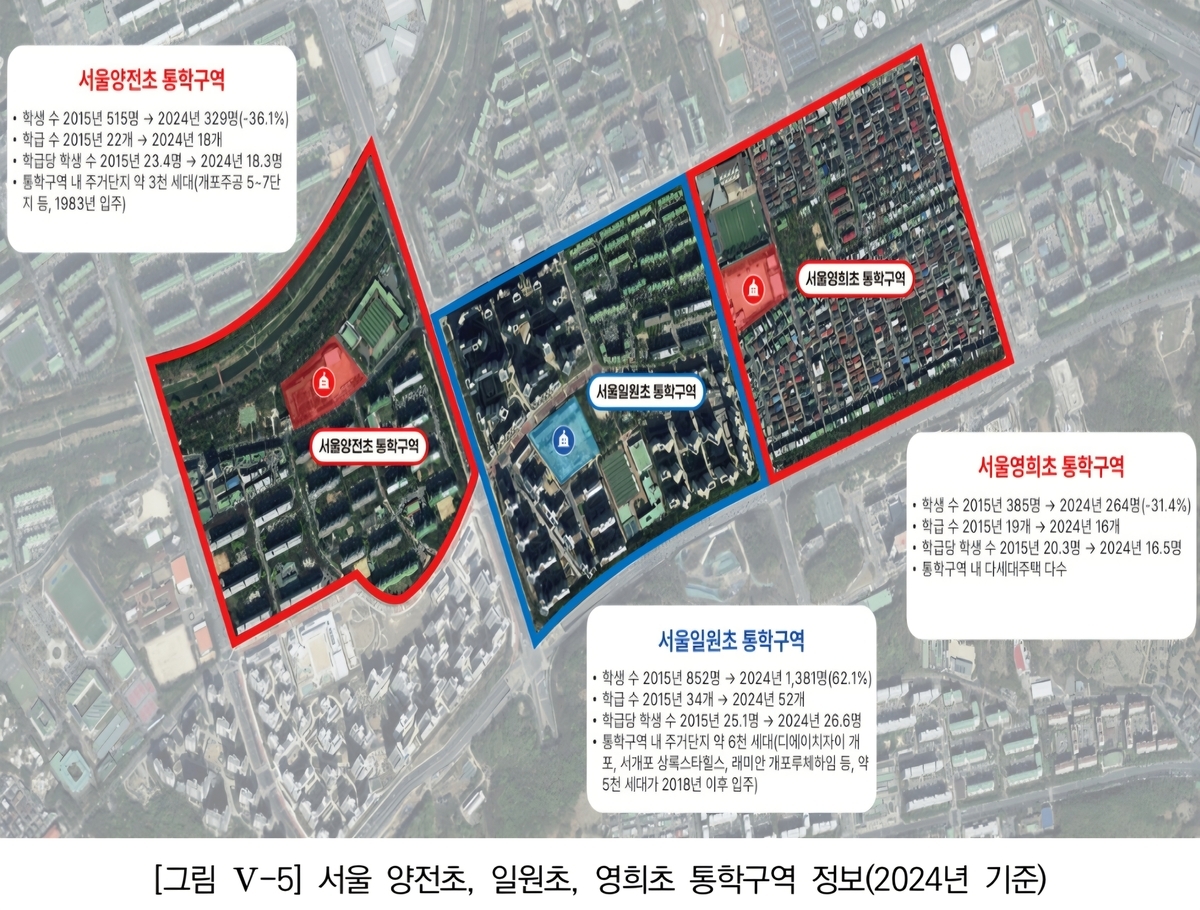
Housing conditions appear to play a significant role. Schools surrounded by multifamily homes and older, relatively low-priced apartments tend to be less favored than those near higher-priced housing complexes.
In a 2024 case study of a neighborhood in Gangnam-gu, the institute found that a school adjacent to a newly built large-scale apartment complex had over 1,000 more students than two nearby schools.
Over the past decade, enrollment at the other two schools fell by more than 30 percent, while the school near the new complex saw a 62 percent increase, even though some of the new apartments were physically closer to the other schools.
“If overcrowded schools continue to expand while underenrolled schools see their functions shrink, this could, in the long term, affect overall education administration, including class operations, teacher allocation and budget planning,” the report stated.
Experts say narrowing the gap will not be easy because it reflects deeper structural changes.
“Stigmatization of lower-cost housing has been consolidating, and it cannot be changed simply by efforts to improve perceptions of rental housing, including public apartments,” said Kim Yun-tae, a sociology professor at Korea University.
He added that rental housing should be supplied in a more balanced manner, with adequate scale and facilities, and that broader efforts are needed to address income and asset disparities, along with increased support for small schools.
The institute also called for legislative reforms to better align school placement with student population trends.
Under the current system, education offices oversee school size and class numbers, while local governments determine school placement, limiting the reflection of current and projected enrollment in planning.
It recommended establishing a legal basis to ensure that metropolitan and provincial offices of education can incorporate educational demand and appropriate school size from the early stages of urban planning.
forestjs@heraldcorp.com