19-year impasse reflects infrastructure costs, not government resistance

For 19 years, Google has been asking South Korea for permission to take the country's detailed 1:5000 map data overseas. For 19 years, Seoul has said no. The conventional explanation is national security: Korea is technically still at war, and precise maps in foreign hands pose a risk.
But last week, Google submitted a revised proposal that effectively undermined that narrative. It now meets virtually every security condition the government had set.
The one thing it refused to include was a plan to build a data center in Korea.
For Yoo Ki-yoon, former director of the National Geographic Information Institute, the government agency that produces Korea's base maps, framing this as a regulatory or server location dispute misses the point.
"If the economics justify it, Google will come in, pay taxes and compete. That's what happened in Japan recently," Yoo, a professor of geospatial engineering at Seoul National University, said in an interview with The Korea Herald. "The reason Google hasn't done so in Korea is not that it's being blocked. It's simply that the company has decided the returns don't yet justify the cost."

The cost Google is weighing extends well beyond running map servers. It's about what a physical presence would trigger. Google Korea reported just 386.9 billion won (about $268 million) in revenue for 2024, paying 17.2 billion won in corporate tax. But estimates presented to the National Assembly by Jeon Seong-min, a professor of business at Gachon University, place the company's actual Korean earnings from YouTube, the Play Store and advertising at between 4.8 trillion and 11.3 trillion won, figures derived from US Securities and Exchange Commission filings and domestic corporate disclosures.
The gap reflects a corporate structure that routes most revenue through low-tax jurisdictions. A Korean data center would expose that structure to scrutiny, Yoo argued, "not just for maps, but potentially for every Google service Korean users consume."
Naver Maps holds roughly 68 percent of the domestic maps market, bundled into a search and commerce ecosystem Google has never cracked. "A standalone map service doesn't generate enough (revenue) to justify the tax obligations a local data center would set in motion for Google," he said.
Every commercial map in the country is built on top of the government's base map, infrastructure created with public funds over decades. The principle, as Yoo put it, is straightforward: "You want to use public infrastructure to make money, you set up locally and pay your share."
Why not just fix the tax system?
A potential counterargument is that tax and map policy should be handled separately: collect taxes through tax reform, and evaluate map exports on their own merits. Yoo called this "unrealistic in practice."
"If you design a system to impose equal costs on Google, it inevitably extends to every other global IT business operating in the country," he said. A digital services tax or comparable levy would need to apply across the board, simultaneously raising the difficulty of institutional design and the risk of trade friction. "Case-by-case responses using existing legal tools are the realistic alternative," he said.
Economic studies don't hold up
Yoo was equally direct about the economic research that has consumed the debate. A research preview by urban policy professor Jung Jin-do from Korea National University of Education last week estimated exporting the data could cost Korea up to 197 trillion won over a decade. On the other side, a 2024 study by The Korea Academic Society of Tourism and Leisure projected 3.4 million additional tourists per year from improved Google Maps.
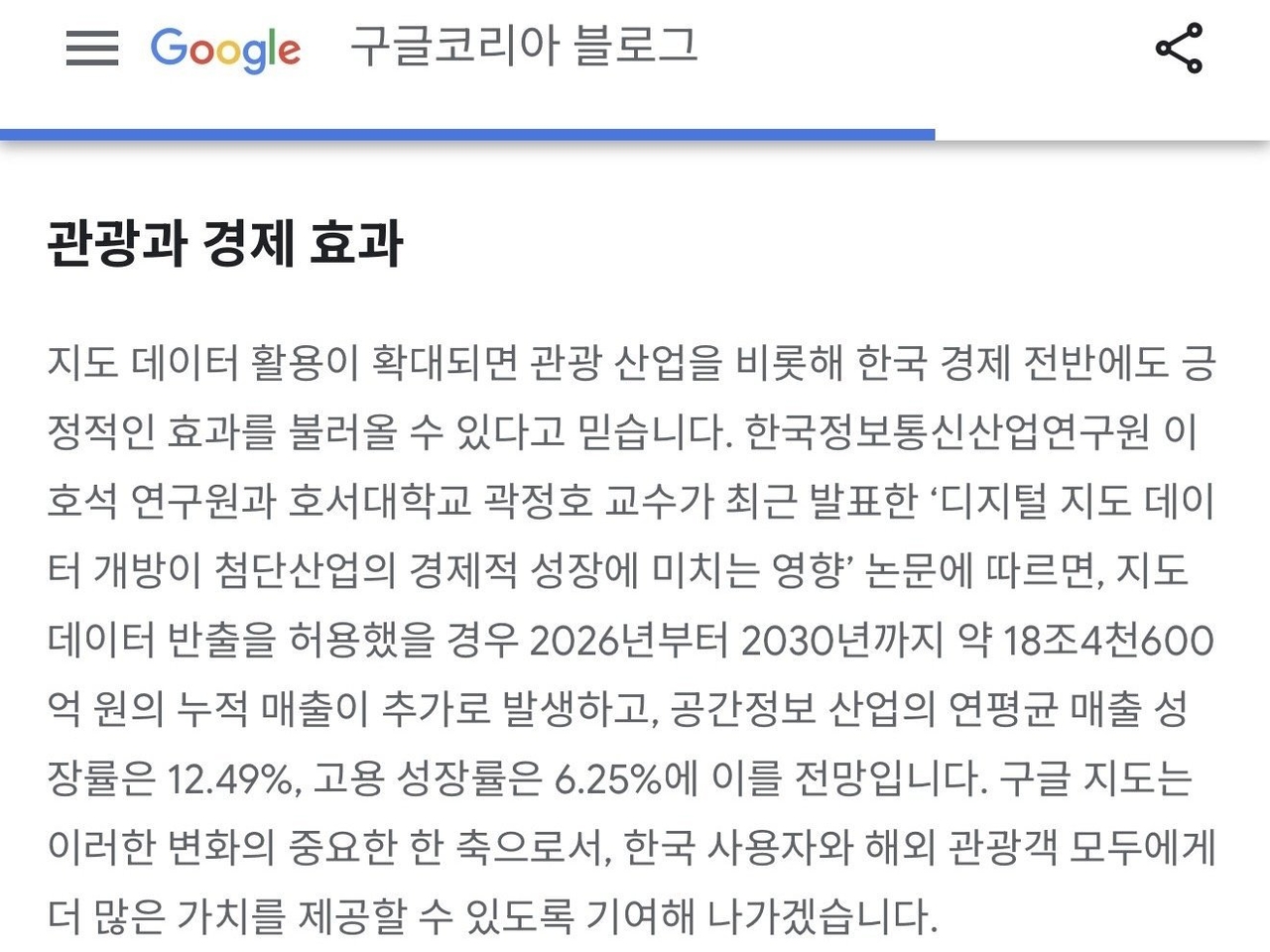
A third paper published in August 2025 cited Google's own blog, claiming that 18.46 trillion won in cumulative industry gains would accrue over five years if South Korea allowed the map export.
"None of the research is remotely credible," Yoo assessed. The 2025 paper Google cited was not even published in a peer-reviewed journal, he noted, calling it "closer to a report than an academic paper."
The fundamental problem, he argued, is that such research may be structurally impossible. "Maps are entangled with advertising, navigation, commerce and mobility platforms. No one can reliably isolate the economic effect of map data alone."
What breaks the deadlock
If the economic arguments cancel each other out, what resolves the 19-year impasse? Yoo believes the answer lies not in Seoul but in Mountain View.
Google's next generation of services will be far harder to run without local infrastructure. Waymo's autonomous vehicles need precise 2D navigation maps to calculate routes in every market they enter. Augmented-reality smart glasses need street-level data to anchor information onto the physical world. Korea, with the world's highest smartphone penetration and a major automotive economy, becomes "a market you cannot bypass," in his view.
That changes the math. Google Maps alone does not justify a Korean data center. But Waymo plus smart glasses plus every location-based service that follows "can potentially flip the equation." Yoo pointed to Japan, where Google began building local server infrastructure in 2023 once the returns justified it.
"When the numbers work, Google will voluntarily build here, pay taxes and compete on equal terms."
Until then, Korea's position requires no action at all. "We are not asking Google for anything," Yoo said. "Google is asking us. And we have no reason to say yes for free."
mjh@heraldcorp.com






![[인터뷰] 구글 지도 반출 19년 교착…"막힌 건 안보가 아니라 수익성"](https://wimg.heraldcorp.com/news/cms/2026/02/13/news-p.v1.20260212.a1df6a111ac343629a0e9335485a7a2f_T1.jpeg?type=h&h=240)