After more than a decade of delays, redesigns and conflicts, Hyundai Motor Group has finally secured the green light to move forward with its long-stalled headquarters project in southern Seoul.
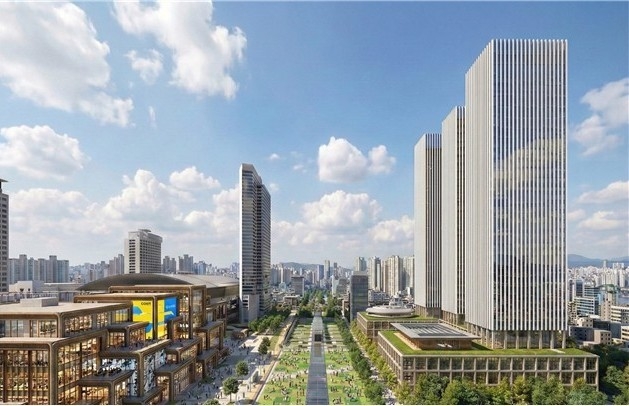
The Seoul city government said last week that negotiations over Hyundai’s Global Business Complex in Samseong-dong had been completed. Under the new plan, the automaker will build three 49-story towers, scaling back from an initial plan for a 105-story supertower, with completion by 2031.
From record land deal to frozen megaproject
- In 2014, Hyundai stunned the market with a 10.55 trillion won ($7.18 billion) winning bid to acquire the former Korea Electric Power Corp. headquarters site, marking the most expensive land deal in Korean history.
- Critics warned of a “winner’s curse,” arguing the carmaker had overpaid to outbid Samsung Electronics.
- Hyundai’s vision was a 105-story, 569-meter skyscraper that would have overtaken Lotte World Tower as Korea’s tallest building.
- In 2016, a preliminary deal with Seoul Metropolitan Government approved the supertall tower in exchange for 1.7 trillion won in public contributions.
Military objections
- Defense authorities brought up national security concerns, warning the tower could interfere with radar systems.
- The issue was conditionally settled in 2019 when Hyundai agreed to fund new military radar equipment, but years were lost in negotiations.
Religious opposition
- Bongeunsa Temple, directly across from the site, strongly opposed the tower due to concerns about blocked sunlight and potential damage to its centuries-old national treasures.
- The project faced disruptions from protests during environmental reviews and became entangled in a long-running land ownership lawsuit that wasn’t resolved until late 2024, when the Supreme Court ruled in favor of the government and Hyundai.
Rising costs
- COVID-19-era spikes in labor and material prices made the supertall tower increasingly expensive.
Goodbye, 105 stories — and a final compromise
- Feb. 2024: Hyundai officially scrapped the 105-story plan, proposing mid-rise buildings, only to face pushback from city officials over reduced public benefits.
- Feb. 2025: A revised plan for three towers was submitted.
- Dec. 2025: A final compromise was reached -- three 49-story towers, each 242 meters tall, safely below military limits. Public contributions increased to 1.98 trillion won, the largest ever for a private development in Korea.
Why it matters
- Construction spending of 5.24 trillion won is expected to inject momentum into Korea’s struggling construction sector.
- Seoul estimates a total economic value of 513 trillion won over 26 years, including 1.46 million jobs and more than 70 trillion won in income effects.
- Completion is targeted for 2031, finally putting one of Seoul’s most valuable idle plots back to work.