Designated an illegal facility in 1994, the Dongbu Expressway is set to go underground by 2029
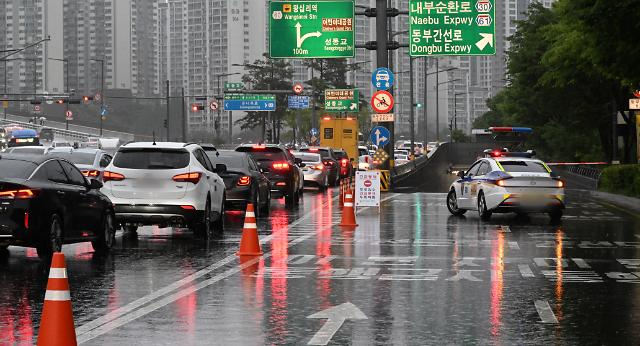
The Seoul Metropolitan Government's recent move to build an underground expressway in the northern part of the city has renewed scrutiny over another aging road structure: a major arterial road stained since its creation 30 years ago by flood risk and its illegal construction.
The Dongbu Expressway in northwestern Seoul runs directly along — and partially occupies — the Jungnangcheon. It was designated an illegal facility in 1994 after authorities concluded it obstructed water flow and increased the risk of embankment overflow.
An enduring illegal structure
Despite the designation, neither the government, which holds permitting authority, nor the Seoul Metropolitan Government, which manages the road, has dismantled it.
In 2008, a land ministry official told local media that “the expressway should have been removed immediately in 1994 for violating the River Act,” but that the government “left it in place because it is a major artery used by about 150,000 vehicles per day.”
The issue dates back to the beginning of the road’s construction in 1989. Back then, the land ministry approved the Dongbu Expressway as a temporary facility covering a 14.5 kilometer stretch from Yongbi Bridge to the Danghyeoncheon junction, on the condition that an elevated alternative road be completed by 1994.
The approval came amid large-scale housing development in Nowon-gu, where mountainous terrain led authorities to route the road along the Jungnang Stream.
As a stopgap measure, parts of the expressway were built directly on river dikes. When the alternative road was never constructed, the Land Ministry formally classified the Dongbu Expressway as an illegal facility under the River Act.
Expanding and undergrounding an illegal road
The dispute resurfaced in 2007, when Seoul proposed widening a 7.6 kilometer section of the road — from Wolgye 1 Bridge to the Uijeongbu city boundary — from four lanes to six. The city sought additional river occupancy, but the ministry rejected the request, saying the existing illegal occupation had to be resolved first.
Negotiations stalled, and in 2011, Seoul began partially undergrounding sections of the highway.
In October 2024, Seoul broke ground for a more comprehensive underground project covering a 12.5 kilometer stretch from Wolneung Interchange in Nowon-gu to Daechi Interchange in Gangnam-gu. The plan, set for completion in 2029, includes a four-lane underground roadway for passenger vehicles running beneath the Jungnang Stream and the Han River, with seven interchanges along the route.
City officials estimate the project will reduce surface traffic on the Dongbu Expressway by more than 40 percent and cut travel time from Wolgye to Daechi from about 50 minutes to roughly 10 minutes.
The undergrounding of the Dongbu Expressway is part of the city's ongoing efforts to modernize antiquated major roads and reclaim surface land for redevelopment.
Another project announced Thursday is the construction of a 20.5 kilometer, six-lane underground expressway linking Mapo-gu in northwestern Seoul to Jungnang-gu in the city’s northeast. Under the plan, sections of the Bukbu Expressway and the Naebu Expressway will be placed underground, allowing space above ground to be redeveloped into parks, housing and commercial facilities.
Seoul Mayor Oh Se-hoon said the project would serve as a cornerstone of a new urban strategy targeting districts north of the Han River, where many major roads were built decades ago and now constrain development.
City officials said maintaining the two existing surface-level expressways already costs Seoul 39.1 billion won ($26.4 million) this year, a figure expected to double as infrastructure continues to age. By contrast, the underground expressway is projected to cut travel time between the two outer districts from 38 minutes to 18 minutes, while reducing noise and improving pedestrian safety.
Seoul currently operates 12 inner-city expressways, most constructed in the 1980s and 1990s during periods of rapid urban expansion.
seungku99@heraldcorp.com