Murder at a tightly secured apartment building remains a mystery after 15 years
South Korea boasts a remarkably high murder case clearance rate, reaching nearly 98 percent in 2022, according to government data. By comparison, the United States solves only around 58 to 60 percent of murder cases.
If you know Korea, it’s not hard to see why. The country is a surveillance-heavy society, where nine out of 10 cars are equipped with dashcams, and security cameras are nearly everywhere, from homes to city streets. In a country so closely watched, it seems almost impossible for a crime to go unsolved.
Yet, despite all this, some cases still defy the odds. Every once in a while, a mystery lingers far longer than anyone expected, slipping through the cracks of even the most vigilant systems.
In this episode, we're looking into one such case.
A woman was found murdered nearly 15 years ago in a high-rise apartment outside Seoul. The building was brand new, equipped with the then-latest security systems, surveillance cameras and digital logs tracking every visitor and vehicle. It should have been impossible to commit a crime without being caught.
Yet today, that case remains unsolved.

Home turned into murder scene
The victim was a 69-year-old housewife, surnamed Lee.
She lived with her 74-year-old husband in a spacious four-bedroom unit on the 14th floor of a 15-story building. The couple appeared to be fairly well-off and, at least on the surface, were enjoying a quiet, comfortable life in their later years.
But on Nov. 17, 2010, what should have been an ordinary day took a horrific turn. That morning, the husband left early for a golf outing, while his wife had little planned other than a casual visit to the apartment complex’s senior club.
Later that night, around 11:20 p.m., the husband returned home, only to find his wife dead in the bloodstained master bedroom.
The husband had left home at approximately 5 that morning, so the wife was alone.
Her last known activity was an 18-minute phone conversation with an acquaintance, initiated at around 8 a.m. The contents of their discussion were mundane and centered on stock investments. This seemingly ordinary call was the last trace of her alive.
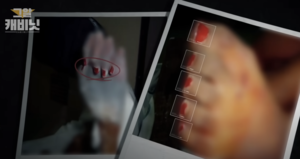
The autopsy result revealed 10 stab wounds to her neck and face, resulting in fatal damage to the carotid artery. An additional 11 wounds were found on her hands, which investigators described as “defense wounds,” indicating her desperate attempt to stop the attack. There was no sign of sexual assault.
The victim's estimated time of death fell within the window of the end of the phone call at 8:18 a.m. to noon.
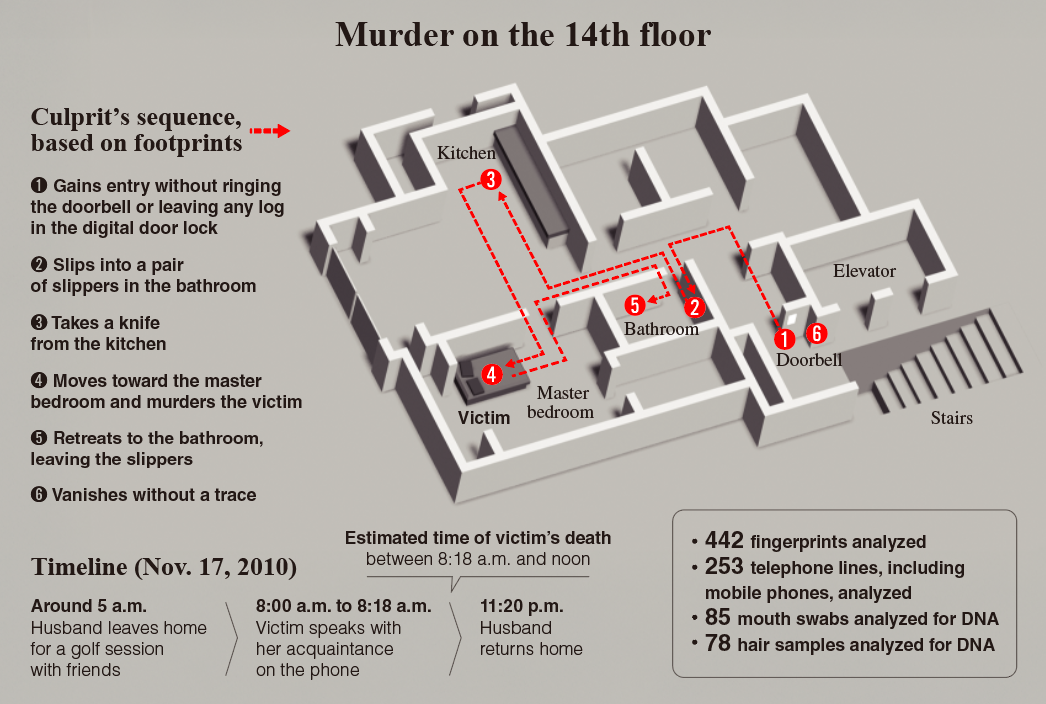
The case was in limbo from the start, as the Namyangju Police Station, handling the case at that time, was unable to extract fingerprints from the murder weapon -- a knife taken from the victim’s kitchen. The shoeprints identified were traced to bathroom slippers from the victim’s home. The slippers were found in their usual place in the bathroom, except they were bloodied.
Tracing the shoeprints, the police formulated a likely sequence: the suspect entered the residence, proceeded to the bathroom to put on the slippers, then went to the kitchen to take the knife, killed the victim in the master bedroom and left the slippers behind in the bathroom before fleeing the scene.
The closet in the second bedroom was left open as if it had been searched, but no valuables were missing.
Gone like a ghost
As mentioned before, the victim’s home was in a tightly secured building designed to record all visitors. Key locations like the elevator, main entrance and underground parking lot had security cameras.
The investigators reviewed surveillance footage from the day of the murder, spanning from 5 a.m. to 11 p.m., and conducted a thorough investigation of 188 individuals captured within the 18-hour timeframe. Drivers who entered the parking lot weren't spared from the investigation.
Despite police efforts, every person identified in the footage possessed concrete alibis, clearing them of suspicion.
Further scrutiny revealed the innocence of the husband, as CCTV footage and statements from his friends affirmed his alibi that he was with them for a golf outing and a subsequent drinking gathering.
Police combed through a week's worth of security footage on the assumption that the killer might have entered the building earlier and lain in wait. Yet, the exhaustive review yielded no usable information.
To access the apartment building, the suspect would have needed to pass through the main entrance and the apartment door, accessible with a card key or password, both of which generate a log.
Intercom systems installed at the main entrance and the apartment door would also have recorded all calls. Yet, no suspicious entries appeared in the footage. No doorbell rang at the couple's home that day.
The theory that the perpetrator used a rope from the roof to break in through the window was quickly debunked. The window was locked, and no signs of rope access were found.
Scrutiny of the security system's data storage, including the visitor log and surveillance footage, revealed no tampering.
This seems to leave only one possibility – the suspect walked in through an open door.
Culprit sketch
Based on the evidence, this was the closest the police could get to narrowing down the suspect:
The perpetrator might have been someone familiar to the victim, likely a resident within the building who was aware of the layout of the victim's home.
The killer could have bypassed the doorbell and gained entry through an open door, or one opened by the victim after a simple knock, and accessed the bathroom and kitchen unimpeded before the attack in the bedroom. The absence of any trace of bloody clothing at the scene pointed towards a well-planned crime, with a motive other than theft.
The 11 defensive wounds on the victim’s body suggest the victim fought back hard or the attacker did not overpower the victim easily. This could mean the attacker may have been old and lacked the strength to do so.
On the assumption that the culprit took advantage of the camera blind spots of the stairwells, the investigators scoured the stairs from the first to the top floor for any traces of blood to no avail.
Further extensive blood tests on all 48 apartments in the building, including even the vacant units on the second and third floors, yielded nothing.
Police learned that the victim had a minor altercation with one of her neighbors -- an elderly woman -- over drying chili peppers on the communal rooftop. Despite further searching of the neighbor's apartment for any blood traces or evidence, nothing was found to implicate the neighbor in the victim’s death. A solid alibi and a passed polygraph test also helped clear her name.
Five years of investigation came up empty, and in January 2016, the case was officially closed, still unsolved.
So, where did the investigation go wrong? Did they miss something? Could a fresh, thorough review finally break the silence?
With public attention on this case all but faded, the burden now falls on the cold case unit of the local police to uncover the truth and bring her killer to justice.
This article is a written adaptation of The Korea Herald's podcast True Crime. You can listen to the full episode on Spotify and Podbbang. ― Ed.